

Loneliness has surprisingly little to do with how many people are around you – and everything to do with whether any of them actually see you.
The word conjures an empty room – no calls, no visitors, days passing in silence. Sometimes that’s exactly what it is. But loneliness shows up just as often inside a full house: a busy job, a long marriage, a packed diary – with the quiet sense of not quite being met by any of it.
That distinction matters, because the two versions need different remedies. Loneliness that follows a move, a breakup, or a bereavement tends to ease as new connection builds around it.
Loneliness that’s been there for years – the kind that starts to feel like a personality trait – is stickier. It can persist even when people are available, because expecting to be misunderstood has quietly become the safer bet.
Worth knowing
A few things about loneliness rarely make it into the popular version of the story:
- Loneliness and solitude aren’t the same thing. Solitude is chosen and often restorative; loneliness is the gap between the connection you want and the connection you have – you can feel it in a crowd, or not feel it at all alone.
- It has a real physical cost. Chronic loneliness has been linked to markedly worse long-term health outcomes, with an effect size that sits alongside long-recognised risk factors like smoking or inactivity – not a vague unhappiness, a measurable one.
- Being partnered doesn’t switch it off. Loneliness inside a marriage or long relationship is well documented, and tracks with the quality of the connection rather than simply whether a partner is present.
- Social media tends to widen the gap, not close it. Passive scrolling – watching other people’s curated connection without any real contact of your own – reliably correlates with feeling more isolated, not less.
- It gets harder to name as people age. Bereavement, retirement, and shrinking social circles compound quietly, so loneliness in later life is often the accumulation of several ordinary losses rather than one dramatic one.
Why loneliness is different
The common advice – join a club, download an app, put yourself out there – treats loneliness as a logistics problem: not enough opportunities for contact. For situational loneliness, that’s often true, and it helps.
Chronic loneliness runs on a different mechanism. Feeling unseen for long enough sharpens a kind of social vigilance – a tendency to scan interactions for signs of rejection and withdraw before it happens. The withdrawal then produces the very distance it was trying to avoid, whether or not anyone else has actually pulled away.
What actually helps
Quantity of contact matters less than quality. A short, genuine exchange – with a neighbour, a shopkeeper, a colleague – tends to do more for loneliness than a longer conversation held at arm’s length.
Repetition helps more than intensity. The same walking route, the same class, the same café at the same time each week builds low-stakes familiarity – the kind that doesn’t require vulnerability to start, but often leads there anyway.
And the self-critical voice that often accompanies loneliness – the sense that you’re somehow the reason people keep their distance – is worth questioning directly rather than accepting as evidence. It rarely holds up to actual scrutiny.
The long view
Loneliness isn’t proof that something is wrong with you. It’s a signal, the same way hunger or thirst is a signal – uncomfortable, and there to be acted on, not read as a verdict.
It tends to lift gradually rather than all at once, in small increments of real contact rather than one decisive fix.
If this is disrupting sleep or everyday functioning, NHS Talking Therapies is worth looking at – free, evidence-based, and self-referral in most of England, no GP needed. If it feels more urgent than that, the Support directory has crisis contacts.
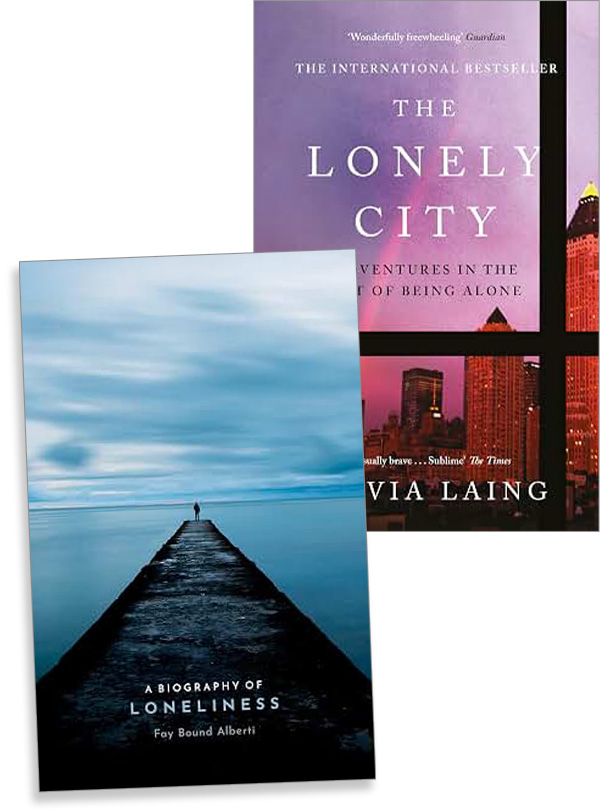
Recommended reading
Historian Fay Bound Alberti’s A Biography of Loneliness traces loneliness as a genuinely modern emotion – she argues its language barely existed before 1800 – and draws a useful line between loneliness that passes and the chronic kind that settles in as identity. Understanding it as a historical, social phenomenon rather than a personal failing is, in itself, a kind of relief.
Olivia Laing’s The Lonely City takes the opposite approach – a memoir of living alone in New York, read through the work of artists including Edward Hopper and Andy Warhol who made loneliness their subject. It’s less a self-help book than good company for anyone who recognises the particular loneliness of a crowded city.