
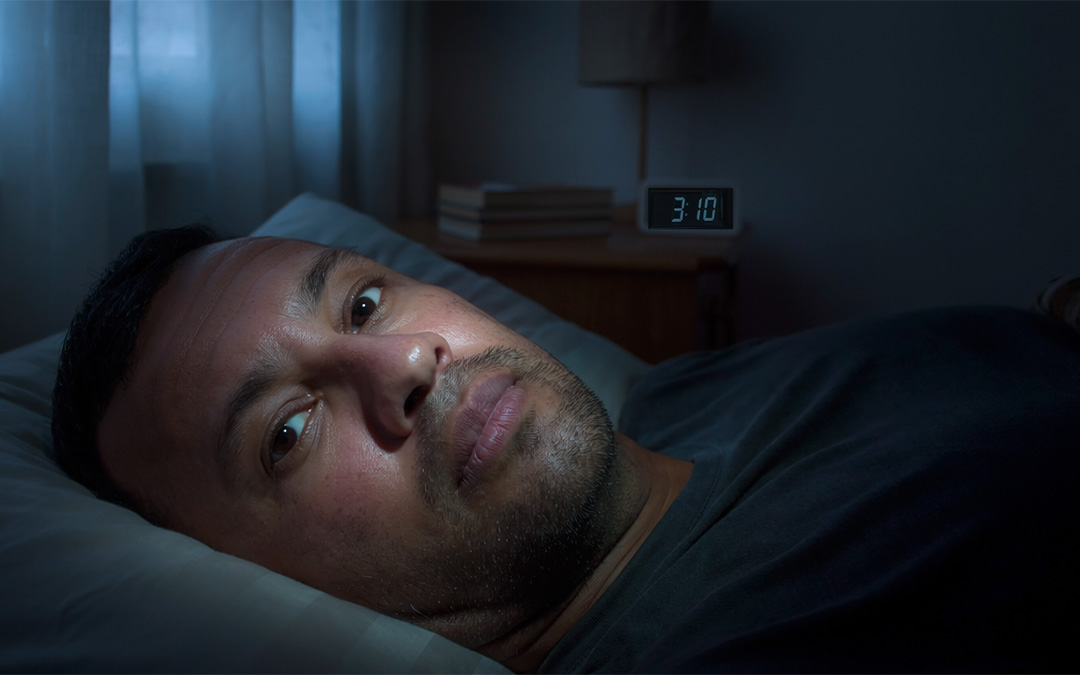
The harder you try to fall asleep, the more awake trying makes you. Lying there running through tomorrow, or worrying about how tired tomorrow will feel, is often what’s actually keeping the night going.
Sleeplessness and worry tend to arrive together, and each makes the other worse. A worried mind is too alert to drift off; a wakeful night gives that mind hours of uninterrupted time to worry in.
By the second or third hour of lying there, the original worry has usually been joined by a new one: whether tonight is becoming a pattern. That second worry is often the one actually keeping you awake.
Trying harder to sleep doesn’t produce more sleep. It produces more trying – which is itself a form of arousal, and arousal is the one thing incompatible with falling asleep.
A few things make sleepless nights harder to break out of, and easy to make worse without realising it:
- It’s the trying that keeps you awake, not the not-sleeping. Sleep isn’t something you can force by wanting it more – effort and pressure are themselves a form of alertness, working directly against the goal.
- Checking the time makes it worse. Looking at the clock turns an ordinary wakeful stretch into a countdown and a source of fresh alarm, adding pressure exactly when the aim is to reduce it.
- Worry about sleep becomes its own separate problem. Once a few bad nights happen, the fear of another one can start driving the insomnia more than whatever triggered it in the first place.
- Not every app claiming to help is doing the same thing. Some are built on properly tested therapy; many are closer to a pleasant distraction – both can have a place, but they’re not interchangeable, and it’s worth knowing which is which.
- It can tip into something more. Sleeplessness that’s lasted weeks, or that’s tangled up with a broader sense of dread, is worth acting on – NHS Talking Therapies (self-referral, no GP needed) is built for exactly this. If it feels more urgent than that, the Support directory has crisis contacts.
Why this happens
Sleep researchers describe a cognitive model of insomnia in which excessive worry – about not sleeping, and about how tomorrow will suffer for it – triggers exactly the kind of arousal that prevents sleep.
The body can’t tell the difference between worrying about a wolf and worrying about tomorrow’s meeting. Either way, it responds by staying alert.
This is also why sleeplessness so often outlasts whatever caused it. A stressful week ends, but the habit of lying awake and dreading the next bad night can carry on well after the original stress has passed.
What actually helps
Getting out of bed after roughly twenty minutes of being unable to sleep, rather than lying there trying harder, tends to help – it breaks the association between the bed and wakeful frustration.
Removing the clock from view, or resisting the urge to check it, removes one of the most reliable ways a wakeful stretch turns into a spiral.
On apps specifically: cognitive behavioural therapy for insomnia is the most well-evidenced treatment available, ahead of medication in most clinical guidelines – and a small number of apps deliver a genuine, clinically tested version of it.
Most others, including the ambient sound apps covering white noise or rain, are a more modest thing: pleasant, sometimes useful, but not built on the same evidence.
Worth knowing
One bad night rarely matters as much as it feels like it does at 3am. It’s the pattern, not any single night, that’s actually worth paying attention to.
Most people have stretches of poor sleep at some point, usually tied to a specific period of worry, and most resolve without becoming a lasting problem.
If it’s been going on for a month or more, or the dread of another bad night is itself taking over the evening, that’s worth treating as its own problem rather than just waiting for it to lift.
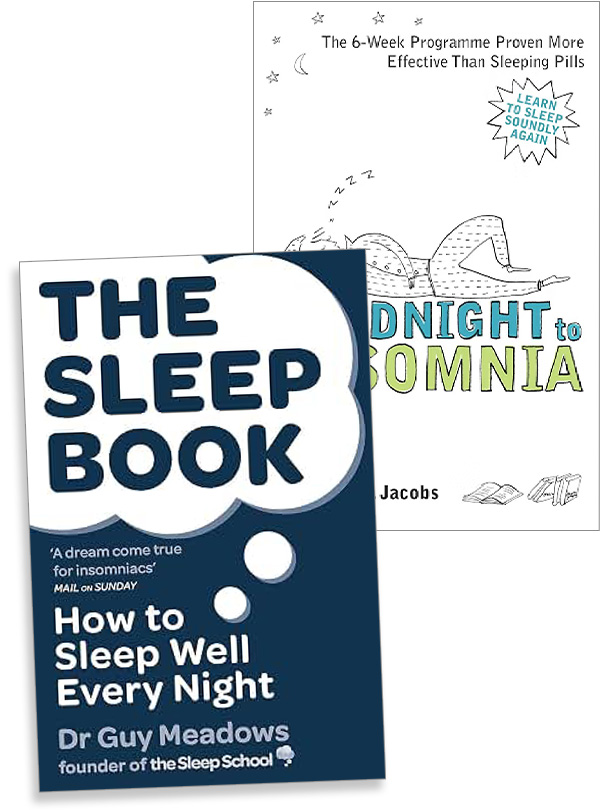
Recommended reading
Guy Meadows’s The Sleep Book is a British sleep physiologist’s approach built specifically on breaking the trying-to-sleep cycle – using acceptance-based techniques rather than another set of rules that can themselves become one more thing to get anxious about.
Gregg Jacobs’s Say Good Night to Insomnia takes the more structured route – a six-week, Harvard-developed CBT programme, and one of the original books that brought this approach to a general audience.