

Most grief starts after something ends. This kind starts while it’s still happening – which is exactly what makes it so hard to grieve, and so hard to explain to anyone else.
Dementia. Addiction. An estrangement that never quite becomes final. In each of these, the person hasn’t died – but a great deal that made them who they were has already gone, and there’s no funeral for that kind of absence.
This is sometimes called ambiguous loss: grief without the clarity of an ending, for something that’s missing but not, technically, over.
It’s different from grieving toward a death you can see coming. There, an ending is known and approaching. Here, there may be no ending in sight at all.
That’s also what separates this from anticipatory grief. That kind of grief looks forward to a known future loss and resolves, in a sense, once that loss arrives.
What’s described here has no future date to look toward – a parent with dementia might live another decade in that state; an addiction might continue for years.
Researchers have increasingly moved away from calling it “anticipatory” at all, precisely because the loss is already happening, on repeat, with no finish line.
What’s described here has no future date to look toward – a parent with dementia might live another decade in that state; an addiction might continue for years.
Researchers have increasingly moved away from calling it “anticipatory” at all, precisely because the loss is already happening, on repeat, with no finish line.
Worth knowing
A few things make this kind of grief harder to recognise, in yourself and in what other people expect from you:
- There’s no ritual for this kind of loss. Funerals, wakes, condolence cards – almost none of it applies to a slow, ongoing disappearance while someone is still, technically, here.
- Hope and grief aren’t a contradiction here. It’s possible to keep hoping for improvement while also mourning what’s already gone, and to feel disloyal for doing both at once.
- It resurfaces at every further stage, not once. Each new decline, relapse, or failed reconciliation can reopen the grief freshly, rather than the grief settling once and staying settled.
- Other people often don’t recognise it as grief at all. Because nobody has died, this loss is frequently met with practical advice instead of the sympathy a death would receive.
- It can tip into something more. Persistent low mood, exhaustion that isn’t lifting, or a sense of dread that colours everything are worth acting on – NHS Talking Therapies (self-referral, no GP needed) is built for exactly this. If it feels more urgent than that, the Support directory has crisis contacts.
Why this happens
Most grief theory assumes a single dateable event after which mourning can properly begin. Ambiguous loss doesn’t offer that starting point, which is precisely why it’s often harder to process, not easier.
Without an ending, there’s nothing to formally mourn yet nothing to keep hoping will return to normal, either. The grief sits in that gap, unresolved by design.
The uncertainty itself is often the hardest part – not knowing whether things will improve, stay the same, or get worse keeps the situation feeling unfinished, in a way a clear ending wouldn’t.
What actually helps
It helps to name the loss as loss, even while the person or relationship is still present in some form. What’s gone doesn’t need to be total to be real and worth grieving.
Holding two things as true at once – continuing to hope, while also grieving what’s already changed – isn’t a contradiction to resolve. Both can simply exist together.
Where possible, it helps to find some form of ritual anyway, even an informal one. Marking a stage of decline, or a point of acceptance, can offer some of what a funeral offers elsewhere.
Living alongside it
This kind of grief doesn’t resolve when the situation does. By the time it does, the grieving is often already well underway.
Ambiguous loss can continue for years, sometimes decades, without the situation ever reaching a clear resolution – and the grief adjusts to that reality rather than waiting it out.
If it’s becoming difficult to function, or the uncertainty itself feels unbearable day to day, that’s a recognised and treatable form of grief, not something to simply endure alone.
Recommended reading
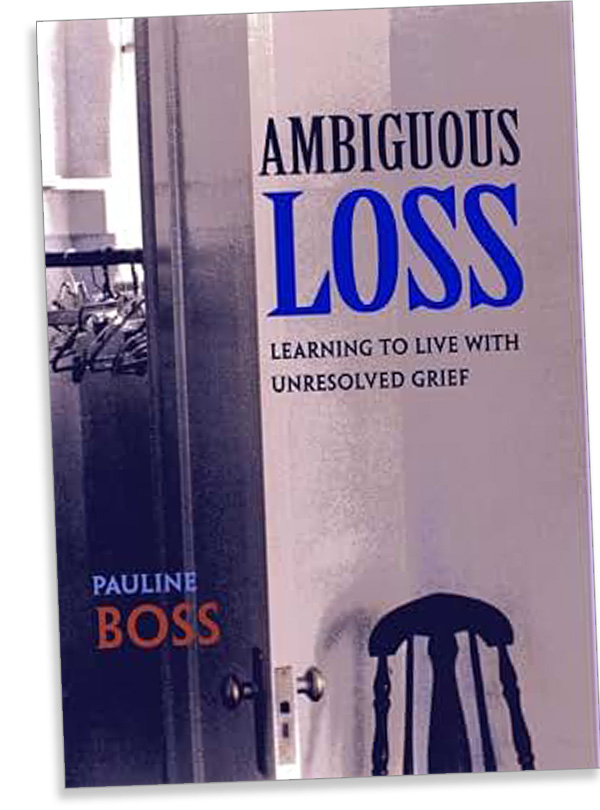
Pauline Boss’s Ambiguous Loss is the book that named this experience and remains the clearest account of it – written by the researcher who first identified the pattern, for exactly the situations this page describes.