

There’s no ceremony for losing a friend. No time off work, no cards, often not even a clear ending – just a slow quiet that leaves you unsure whether it’s really over.
Most friendships don’t end with a conversation. Research into how friendships actually end found the two most common patterns were physical separation and slowly replacing old friends with new ones – not a single blow-up, but a quiet drift that’s often only obvious in hindsight.
That ambiguity is its own kind of hard. Grief that follows a clear ending – a death, a formal breakup – has a moment to organise itself around.
A friendship that fades doesn’t offer one, so the grief has nowhere obvious to land, and it’s easy to spend months unsure whether you’re mourning something or just imagining it.
It also tends to go unacknowledged by other people, even when it’s genuinely disorientating. There’s no accepted script for how sad you’re allowed to be about a friend – which doesn’t make the loss smaller, just harder to talk about.
Worth knowing
A few things about losing a friend rarely make it into the popular version of the story:
- It has a name: disenfranchised grief. A psychologist coined the term directly in 1989 to describe losses that aren’t socially recognised or supported – the end of a friendship was one of his original examples, alongside divorce and job loss.
- Most friendships end quietly, not dramatically. Research into how friendships actually dissolve found the most common patterns were physical separation and gradually replacing old friends with new ones, rather than a single decisive conversation.
- Adult friend networks are already smaller than they feel. Life transitions – moving, having children, changing jobs – reliably shrink the number of close friends people keep, so losing one carries more weight than it might have earlier in life.
- The lack of a clear ending is often the hardest part. Psychologists call this “ambiguous loss” – grief without a defined moment of closure – a concept developed for far more dramatic situations that applies just as well to a friendship that simply fades.
- Grieving it can feel like it needs justifying. There’s no accepted script for how sad you’re allowed to be about a friend, which is exactly what makes naming it clearly – to yourself, if no one else – worth doing.
Why this grief is different
The common framing treats a lost friendship as a minor life adjustment – something you quietly get over, the way you’d stop using a gym membership. Losses with recognised rituals get support and a script for what happens next. This one gets neither.
It’s also rarely a single event to process. Because the ending is often gradual and undeclared, there’s no fixed point to date the loss from – which means the grief doesn’t follow the shape people expect it to, and can resurface at odd, seemingly unrelated moments.
What actually helps
Naming it as a real loss – out loud, to yourself or to someone else – tends to help more than waiting for an external ritual that isn’t coming. The absence of a ceremony doesn’t mean the loss doesn’t deserve one.
Letting the ending stay unexplained, when it doesn’t come with a reason, is sometimes the only realistic option. Not every friendship ends with an answer, and holding out for one can keep the grief circling longer than it needs to.
And protecting the friendships that are still there matters more than it might seem – given how few close friendships most adults maintain at any one time, the ones that remain are doing a lot of the surrounding-support work by default.
Not a small loss
A friendship doesn’t need to end badly to be a real loss. It just needs to have mattered.
It tends to ease the way other grief does – unevenly, and without a fixed timeline – even without the rituals that usually mark a loss as real.
If this is disrupting sleep or everyday functioning, NHS Talking Therapies is worth looking at – free, evidence-based, and self-referral in most of England, no GP needed. If it feels more urgent than that, the Support directory has crisis contacts.
Recommended reading
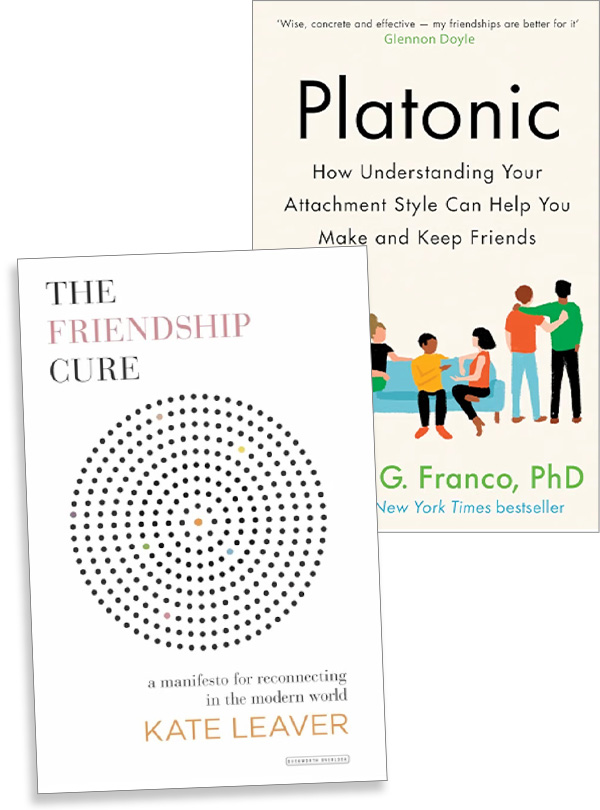
Kate Leaver’s The Friendship Cure is a journalist’s wide-ranging exploration of modern friendship, blending research with real stories – including a direct, practical look at how to “break up” with a friend, and why the loss deserves to be taken seriously.
Marisa Franco’s Platonic takes a more research-grounded route, using attachment theory to explain how adults form, maintain, and lose friendships – a genuinely different register from Leaver’s journalistic approach, and useful for understanding the mechanics behind why some friendships fade and others don’t.