

Close relationships grow through ordinary moments: asking about someone’s day, sharing a meal, making time to listen, or letting someone know what is happening in your life.
This might be with a friend, partner, relative or someone you have come to trust. Closeness can take different forms, and does not have to involve romance or physical affection.
Staying in touch can be difficult when time, energy or distance get in the way. A short message, a phone call or a familiar activity together can be a manageable place to begin.
You do not have to share everything. You might talk about one thing that matters to you, ask for a little support, or simply spend time together without a difficult conversation.
Look for relationships where care goes both ways and your boundaries are respected. Making room for connection can include choosing where to put your energy, rather than trying to keep every relationship close.
Making time for connection
Choose one person you would like to connect with and a small, realistic way to reach out. Leave room for their preferences and availability as well as your own.
- Make a small, specific invitation. Send a message such as “I was thinking of you. Would you like a short call this week?” Suggest something manageable and give them room to decline or choose another time.
- Ask, then make room to listen. Try “How did that appointment go?” or “What has your week been like?” Follow their lead without pressing for details or immediately offering advice.
- Share something of your own. Talk about an ordinary pleasure, a worry or something you could use help with. Choose what feels comfortable; closeness does not require telling everything.
- Find a way to spend time together. A walk, shared meal, online game or regular phone call can make contact easier to sustain. Agree on a frequency that suits you both.
- Notice how each person welcomes affection. A kind message, practical help or a warm greeting may be appreciated. If you want to offer a hug or other touch, check that it is welcome and respect the answer.
A small exchange can be worth having even if it does not lead to a long conversation. If contact has lapsed, you can acknowledge the gap and offer a simple way to reconnect.
A delayed reply does not tell you everything about how someone feels. Give them time, while noticing whether the relationship makes room for both of you over time.
Connection and health
Social connection is linked with health as well as companionship. A 2010 review by Julianne Holt-Lunstad and colleagues brought together 148 studies involving more than 300,000 people and found that stronger social relationships were associated with a greater likelihood of survival during follow-up.
This is an association across groups of people, not a promise about what an extra phone call will do for an individual. The studies also measured different aspects of connection, including support, social networks and participation in community life.
In everyday terms, other people can offer practical help, listen when things are difficult and notice when you need support. A close relationship can be one part of that wider network.
Finding what works between you
Pay attention to whether you feel heard, respected and able to be yourself. Frequent contact is not enough on its own, and different relationships may offer different kinds of companionship or support.
The popular “love languages” framework suggests that people have a primary way of receiving affection. A 2024 research review found limited support for its central claims, including the idea that matching a partner’s preferred language is the key to relationship satisfaction.
You can still ask useful questions without assigning anyone a category: “Would you like me to listen or help you think it through?” or “What would feel supportive this week?” Preferences can change with the situation.
Closeness also leaves room for privacy, disagreement and time apart. You can care about someone and say no to a request, or ask to have a difficult conversation at a better time.
If a relationship involves fear, coercion or harm, increasing contact is not the aim. Seek support with your safety and choices rather than treating the problem as a failure to communicate.
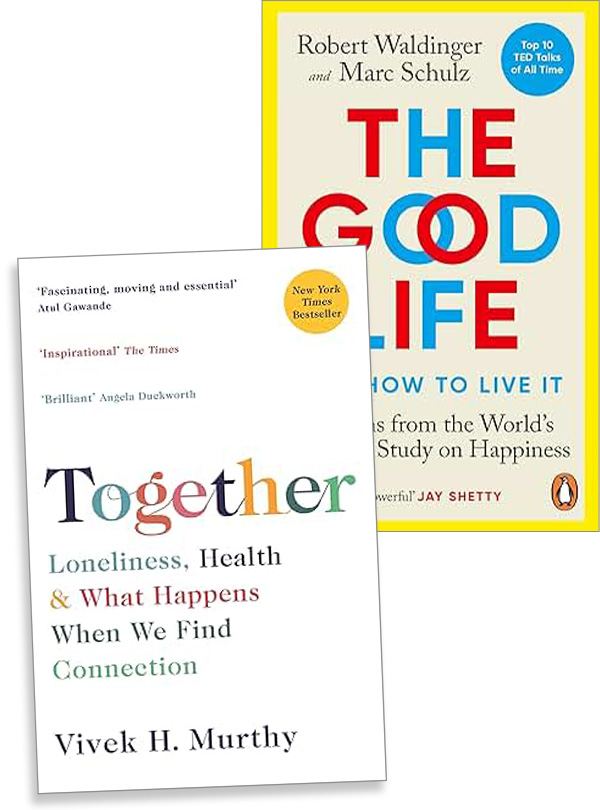
Recommended reading
Vivek Murthy’s Together explores loneliness and the importance of social connection, drawing on research, personal stories and his experience as a doctor. It includes suggestions for making connection part of everyday life.
Robert Waldinger and Marc Schulz’s The Good Life draws on the long-running Harvard Study of Adult Development. It considers how relationships contribute to wellbeing across a lifetime, with practical prompts for reflecting on your own connections.