
A chair covered in clothes, a drawer that will not close, the search for keys before leaving the house. Possessions can add small complications to a day without any one of them seeming worth much attention.
Clearing some space can make ordinary things easier: somewhere to sit, a surface to work on, less searching and moving things aside. The benefit may be practical before it is anything else.
What feels comfortable differs from one home to another. Books, photographs and half-finished projects can make a room welcoming; the same room can become frustrating when there is no space left to use it.
Decluttering is most useful when it starts with that difference — what makes a place feel lived in, and what gets in the way of living there.
Making a little room
One manageable change is enough to begin with. Choose a place where clearing or rearranging a few things would make daily life easier.
- Choose one place that gets in the way. A chair, a drawer or the space by the front door. Start somewhere small enough to finish without taking the whole room apart.
- Decide what needs to stay before finding storage. Some things need a better home; others can be donated, recycled or discarded. More boxes may simply postpone the decision.
- Make everyday things easy to reach. Give keys, paperwork or frequently used utensils a convenient place. A useful arrangement is easier to maintain.
- Take time over things with a history. Gifts and keepsakes can be difficult to sort. Leave uncertain decisions for another day rather than forcing them during a burst of tidying.
- Finish by making the space usable. Put away what is staying and deal with what is leaving. Stop while there is still enough energy to complete that last part.
A cleared table may mean there is somewhere to eat together again. An orderly drawer may save a daily search. Changes like these have a value that is easy to overlook in photographs of perfectly finished rooms.
In a shared home, what gets moved or removed needs agreement. One person’s unwanted clutter may be another person’s useful equipment or treasured collection.
More than things
Possessions often carry unfinished decisions: something to mend, paperwork to deal with, a gift that feels difficult to give away. Sorting them can involve more than finding space.
Some belong to an earlier version of life — clothes for a job that has ended, equipment for a hobby that no longer appeals. Keeping them may be comforting, useful or simply easier than deciding. There is no single rule that settles those choices.
This is part of the appeal of decluttering methods. They offer a question or a sequence when every object seems to require a fresh decision. A method can be helpful without being followed to the letter.
What the research suggests
Research has found links between how people experience their homes and how they feel. A small study of working couples, for example, found that women who described their homes as cluttered or unfinished had patterns of mood and the stress hormone cortisol that differed from those who described them as restful.
That does not show that clutter caused the differences, or that clearing it would reverse them. Pressure at work, limited space, caring responsibilities and exhaustion can affect both the state of a home and the people living in it.
The relationship may run both ways. A difficult period can make household tasks harder to manage; an awkward space can then add further work to an already demanding day.
The practical benefits are easier to assess: whether things can be found, rooms used and everyday tasks done with less effort. Those are useful reasons to make a change, without expecting tidying to resolve wider difficulties.
A home that fits its occupants
A room full of books and objects can be a pleasure. A nearly empty room can feel restful to one person and bare to another. Simplicity is most useful when it makes room for what matters to the people who live there.
The polished homes shown in decluttering media leave much out of view: storage elsewhere, money, time and help. A busy household has different demands, and its arrangements need to work on an ordinary tired evening.
Sometimes the answer is fewer possessions. Sometimes it is a hook in the right place, a basket where things actually get left or sharing the work more fairly.
A good stopping point is when the space does its job more easily. There can still be photographs on the shelves, projects in progress and signs that people live there.
Recommended reading
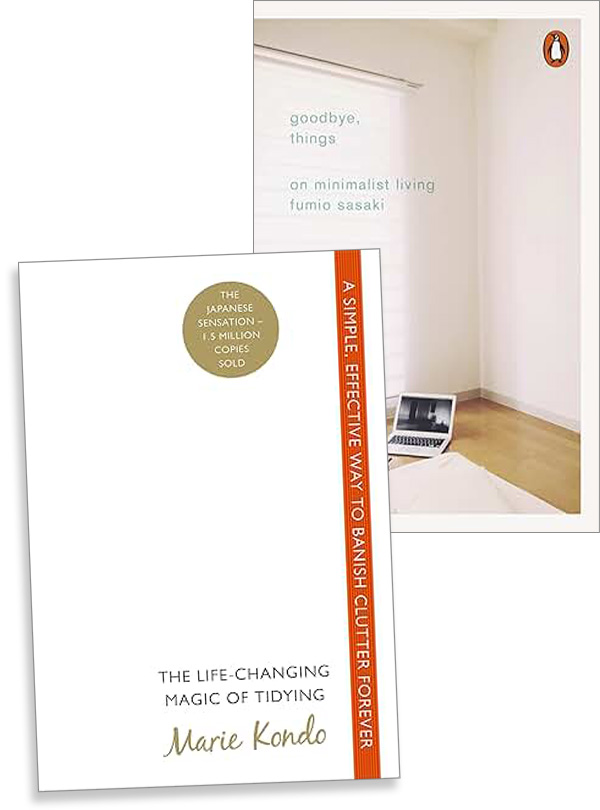
Marie Kondo’s The Life-Changing Magic of Tidying Up offers a structured approach to sorting possessions, with an emphasis on choosing what to keep. Its questions can be useful even without adopting the whole method.
Fumio Sasaki’s Goodbye, Things combines his experience of radically reducing his possessions with practical suggestions. It offers a more minimalist perspective on what owning less can make room for.