

A closer look at NSDR, the calming practice behind the popular new name, and the rest it genuinely offers.
NSDR – Non-Sleep Deep Rest – is becoming an increasingly popular term, turning up in podcasts, on fitness trackers, and across meditation apps such as Insight Timer, which alone now hosts thousands of sessions labelled with the name.
Andrew Huberman, a Stanford neuroscientist and podcaster, introduced the term in 2022 as a secular rebrand of yoga nidra – a lying-down, guided practice of body scanning, breath awareness and attention shifts, aimed at reaching a deeply relaxed state while staying awake.
It’s now one of the most searched terms in wellness. Underneath the new name, though, it’s something this site already covers under Guided meditation.
Huberman has been open about why: he wanted a name without the Sanskrit or the spiritual framing, on the theory that unfamiliar language puts people off trying something genuinely useful. Strip the rebrand away, though, and here’s what’s actually going on:
- It’s not a new technique. Sessions run 10 to 40 minutes lying down, following audio guidance through body scanning and breath work – the same structure yoga nidra has used for decades.
- The evidence holds up. Much of the research behind NSDR comes from decades of yoga nidra studies – reduced stress and anxiety, better sleep quality, calmer physiological markers. The name is newer than the evidence for it.
- One popular claim is still early-stage. The idea that NSDR “restores dopamine” comes from a small study of eight people – a promising early finding, worth treating as a lead rather than a settled fact.
- It’s found a home on the apps. Insight Timer alone hosts thousands of sessions explicitly tagged NSDR, many of them cross-labelled as yoga nidra for anyone searching under either name.
- High-profile fans have helped it travel. Google’s Sundar Pichai has spoken about using it, and it’s become a fixture of tech and productivity culture as a midday reset rather than only a bedtime practice.
Why the name took off
Huberman’s own explanation is candid: complicated or unfamiliar language can be a barrier, and NSDR was designed to remove it.
That’s a reasonable instinct, and it’s clearly worked – search interest in “NSDR” has climbed steadily since 2022, well past where “yoga nidra” ever sat on its own.
A more accessible name has likely brought a genuinely useful practice to people who’d never have tried something called yoga nidra, which is a real benefit whatever you make of the branding.
The practice underneath is the same one, with the same evidence base, whichever name gets you there.
What this doesn’t mean
None of this is a case against the practice itself – lying down, breathing, and letting a voice guide you through a body scan is a genuinely well-evidenced way to settle a stressed nervous system.
It’s a case for knowing what you’re actually doing when you do it. If a guided audio session labelled “NSDR” helps you get through a bad night’s sleep or a stressful afternoon, that’s real and worth keeping.
It just isn’t a different practice from the guided meditation already covered here – and that page’s evidence review applies just as much to a session called NSDR as one called yoga nidra or a body scan.
Recommended reading
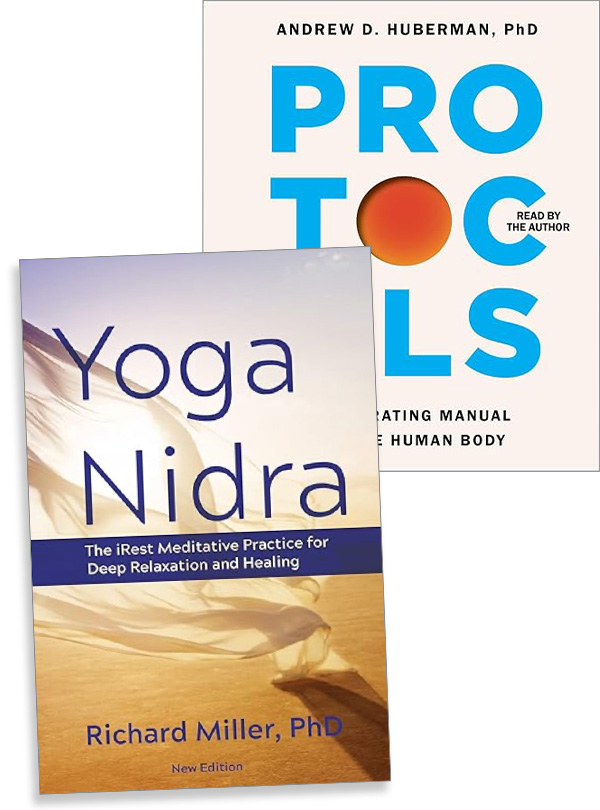
Richard Miller’s Yoga Nidra is the clinical originator’s own account – decades of research with veterans, trauma survivors and chronic pain patients, well before the rebrand gave it a new name.
For something more contemporary, Andrew Huberman’s own Protocols sets NSDR within his much wider set of evidence-based daily practices – useful context for seeing where this one habit fits into his broader approach.
NSDR was coined by Andrew Huberman, Stanford neuroscientist and host of the Huberman Lab podcast. The evidence behind it is drawn from research into yoga nidra, covered more fully on the Guided meditation pathway.