
Stepping out of cold water can leave you feeling very awake: skin tingling, a towel suddenly welcome, an ordinary warm drink more appealing than it was a few minutes before.
For some people, that feeling is worth returning for. Others enjoy the company of a swimming group, the time outdoors or the satisfaction of trying something they were unsure about.
There is room to enjoy those things without turning cold exposure into a test of toughness. You do not need to stay longer, go colder or learn to like it because someone else does.
The broader promise—that choosing discomfort trains you to handle whatever life brings—is less certain. Becoming accustomed to cold does not necessarily make grief, worry or a difficult week easier to bear.
Cold water also asks something of the body. Sudden immersion can disrupt breathing and sharply increase heart rate and blood pressure. A cool shower and an outdoor swim are different experiences, with different risks.
If the practice appeals to you, curiosity is a reasonable starting point. So is deciding that you would rather find your challenge, pleasure or time outside another way.
Keeping the choice manageable
Begin with your health and the setting, rather than a target temperature or time. Any experiment should be easy to stop; seek medical advice first if a health condition could make cold exposure risky.
- Consider your health before the challenge. If you have a heart, circulation or breathing condition, or are unsure whether cold exposure is suitable, speak with a health professional first.
- If you are curious, keep a shower experiment mild. Lower the temperature gradually and keep it brief. There is no particular number of seconds you need to reach.
- Give yourself permission to stop. Keep breathing naturally. Pain, dizziness or difficulty breathing are reasons to stop, rather than something to prove you can endure. Do not combine cold exposure with breath-holding or deliberate rapid breathing.
- Prepare separately for outdoor swimming. Go with others, choose a suitable supervised setting and follow recognised water-safety guidance. Never jump straight into cold water.
- Notice what makes the experience worthwhile for you. It might be the swim, the company or how you feel afterwards. If there is little you enjoy, you can choose another activity.
You might discover that what you like most is the whole occasion: meeting someone early, being outside, then getting warm together afterwards. The cold does not have to explain every good part of it.
Nor does enjoying it once create an obligation. You can leave it occasional, change your mind or find that it suits one season of your life better than another.
A challenge you get to choose
There can be satisfaction in approaching something unfamiliar and finding it manageable. That feeling is understandable, whether it comes from cold water, learning to dance or tackling a steep walk.
But the appeal of a chosen challenge can get tangled up with the idea that harder is always better. A useful experience does not need to become an ordeal, and stopping is part of exercising judgement.
Repeated exposure can make the initial reaction to cold less pronounced. That adaptation is specific enough to deserve care: it does not establish that other difficulties will become easier, or make open water safe.
Behind the bigger promises
Cold exposure attracts claims about everything from immunity to anxiety. The research is more limited than the confidence of those promises might suggest.
A large study of cold showers found fewer self-reported days off work through sickness, but no reduction in the days people actually felt ill. It is an interesting distinction, and a reason to be careful with claims that cold showers prevent illness.
Research involving Wim Hof is often used to support broader claims. A small study published in 2014 tested a programme combining cold exposure, meditation and breathing exercises, then measured participants’ responses during a controlled laboratory procedure.
The results showed that trained participants could influence aspects of their stress and inflammatory responses. They did not establish that cold alone produced the changes, or that the programme treats anxiety or builds everyday resilience.
Research on wellbeing is still developing. Personal accounts of feeling brighter or more alert are worth hearing, but they cannot promise the same experience to everyone.
Finding what is worth returning to
A practice earns its place through what it adds to your life. Enjoyment, company and a reason to get outside are all worth considering, without needing a dramatic health claim.
If you mainly want help with physical tension, breathing practices offer a gentler option. If you are interested in your response to difficulty, Stoic practice gives you another way to explore it.
For outdoor swimming, preparation remains essential however familiar the cold becomes. Follow specialist water-safety advice, and let the conditions and your health guide the decision each time.
Recommended reading
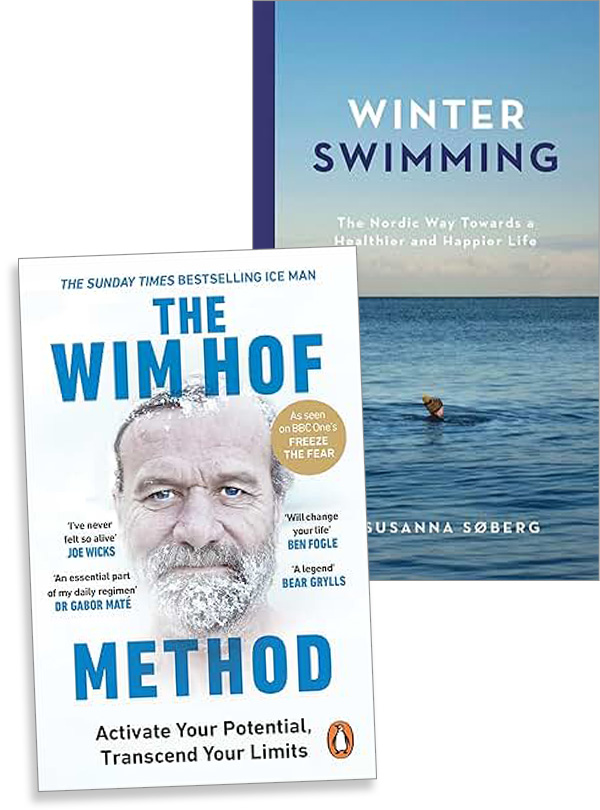
Wim Hof’s The Wim Hof Method tells his story and introduces his approach to cold, breathing and mindset. Read its wider health promises alongside the research limitations discussed above.
Susanna Søberg’s Winter Swimming explores cold-water traditions and the body’s responses to cold, with photographs that convey the appeal of the experience.