
Play can be a card game, making up a story, kicking a ball around or experimenting with sounds. It is time spent doing something because the activity itself interests or amuses you.
Adults can play too, though work, caring responsibilities and tiredness may leave little room for it. You might return to something you once enjoyed or try a small variation on an activity you already do.
Play can be quiet or energetic, solitary or shared. It does not have to involve being silly, performing for others or joining a group.
Games can have rules, scores and skills worth learning. Those do not stop them being play; what matters here is having room to choose, explore and enjoy the experience.
You do not need to become good at it or turn it into a regular hobby. A few minutes of drawing, building, pretending or trying things out can be a place to begin.
Finding your way into play
Choose something that sparks a little curiosity or enjoyment. Keep the first attempt manageable, and give yourself room to change the activity or stop.
- Start with something that interests you. Try a familiar game, doodling, making up a tune or building something from materials you already have. Choose an activity that suits your energy and surroundings.
- Leave room to experiment. Try an unexpected move, invent a character or change a pattern. You can follow rules or agree on new ones with anyone playing alongside you.
- Keep competition enjoyable. Scores and challenges can be part of the fun. If winning or improving starts to crowd out enjoyment, lower the stakes or try a different way to play.
- Let shared play develop together. Ask someone to join you and make room for their ideas. If you are playing with a child in your care, follow their interests rather than turning every activity into a lesson.
- Adjust it to how you feel. Shorten the activity, take a break or switch to something quieter if you become tired or frustrated. There is no need to keep going to make the time worthwhile.
A short spell of play can be worth having simply because you enjoy it. There is no minimum duration, and you do not have to become completely absorbed.
You can care about a result and still be playing. Finishing a puzzle, improving at a game or making something you like can be part of the pleasure, provided you have room to choose how seriously to take it.
What adult play research tells us
Research on adult play often looks at playfulness: the tendency to find amusement, explore ideas or approach situations in a playful way. This overlaps with playing games or making things, but is not quite the same.
Survey studies have found links between greater playfulness and higher reported wellbeing. They cannot establish whether playfulness improves wellbeing, whether feeling well makes play easier, or whether other factors influence both.
There is some experimental evidence too. In a study of 533 adults, brief exercises such as noticing playful moments or trying playfulness in a new way produced short-term improvements in reported wellbeing compared with a control activity.
These findings are encouraging, but they do not establish a particular amount or type of play as a treatment for depression. Research on children and animals also cannot be applied directly to adult wellbeing.
Keeping enjoyment at the centre
You do not need to recover a childhood personality or become more outgoing. Look for activities that suit who you are now, including quiet, thoughtful or solitary forms of play.
Use what is available: paper and a pencil, a familiar game, household materials or an imaginative conversation. Adapt the activity to your mobility, senses, energy and budget.
Shared play works best when people can join in, suggest changes and leave without pressure. Agree on rules or boundaries where needed, especially if competition or teasing is involved.
If an activity becomes frustrating or demanding, you can change it or take a break. Sometimes unstructured rest is more appealing; at other times, humour and laughter may offer a way into something playful.
Recommended reading
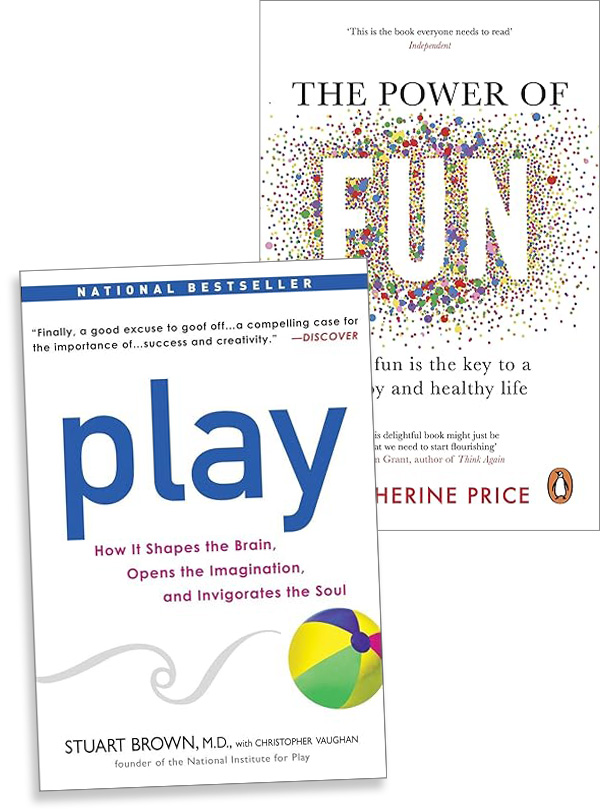
Stuart Brown’s Play, written with Christopher Vaughan, brings together research, observations and personal histories to argue for the importance of play throughout life. It offers a broad perspective rather than a tested programme for improving wellbeing.
Catherine Price’s The Power of Fun takes a practical approach to noticing what you enjoy and making more room for it. Its prompts may help you explore activities and company that suit your interests.