
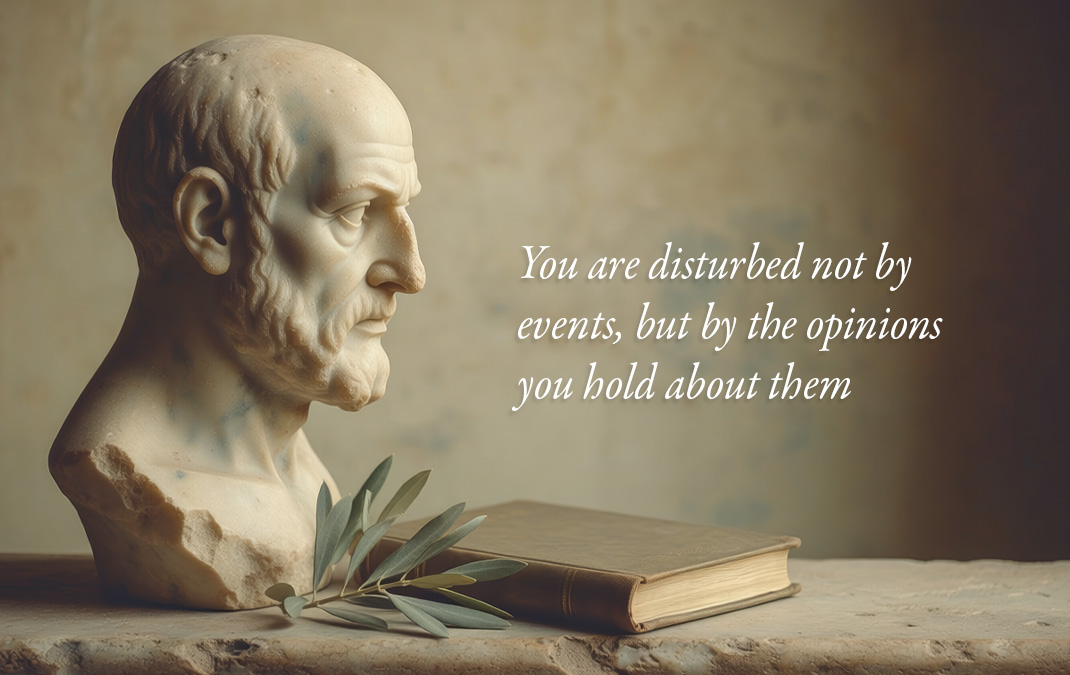
Stoic practice is the deliberate management of our own judgements. Its founding insight is deceptively plain: we are not disturbed by events, but the opinions we hold about them.
The traffic, the rude email, the diagnosis – these arrive as raw fact. The distress is something you add. Stoicism is the discipline of noticing that addition, and learning, with practice, to withhold it.
It’s among the oldest self-help systems ever devised – and one of the few that modern psychology has rebuilt rather than discarded.
How to do it
Stoicism is a practice, not a mood. You don’t feel Stoic; you do the exercises. Here are the plainest three.
- Sort by control. When something troubles you, ask one question: is this up to me, or not? Your effort, your response, your judgement are yours. The outcome, others’ opinions, the past, the weather are not.
- Name the judgement. When distress arrives, separate the bare event from the story you’ve wrapped around it. “She didn’t reply” is the fact. “She’s angry with me” is the addition. Hold the fact; question the addition.
- Rehearse the difficulty in advance. The Stoics called this premeditatio malorum – calmly imagining what might go wrong, not to brood, but to rob it of its shock.
Where it comes from
Stoicism began in Athens around 300 BC, when Zeno of Citium taught from a painted porch – the stoa that gave the school its name.
It’s the Roman Stoics we still read: Seneca the statesman, Epictetus the former slave, and Marcus Aurelius, an emperor writing private notes never meant for us to see.
That range is part of its appeal. The same practice served a slave and an emperor, which suggests it addresses something common to the human condition rather than to any particular circumstance.
After centuries of neglect – dismissed as cold, fatalistic, a philosophy of grim endurance – it returned with force in the 2000s, partly through accessible modern writers, partly because clinical psychology had, without meaning to, rebuilt much of it from scratch.
Worth knowing
Stoicism is easily misused. Taken badly, it curdles into suppression – a way of telling yourself you shouldn’t feel what you plainly do feel.
That’s not Stoicism; it’s avoidance wearing its toga. The Stoics didn’t deny emotion – they examined it, and declined to be ruled by the unexamined kind.
And the technique has real limits – it’s a fine tool for ordinary frictions, not a treatment for clinical depression or trauma.
Recommended reading
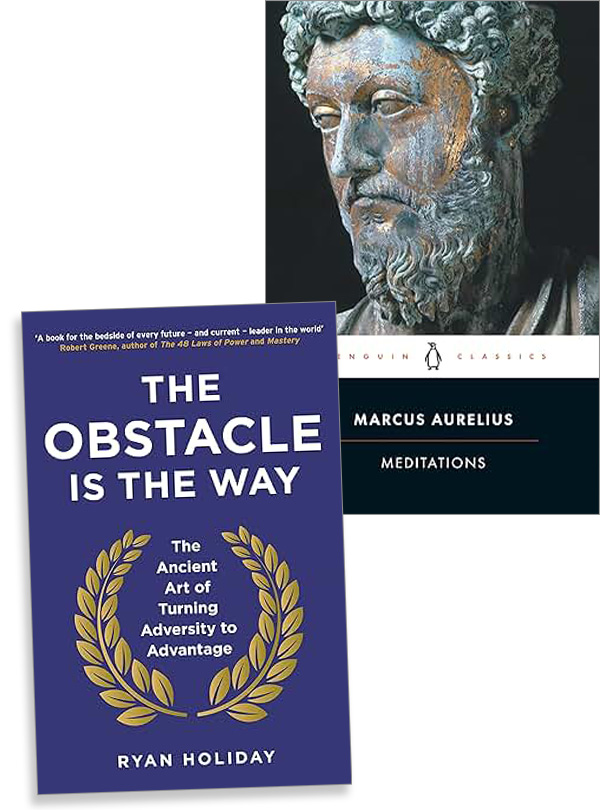
Marcus Aurelius’s Meditations is the gentlest doorway – a man’s private attempt to steady himself, never written with a reader in mind, rather than a lecture aimed at anyone else.
For something more contemporary, Ryan Holiday’s The Obstacle Is the Way takes the same core discipline and applies it directly to modern frustrations, without the toga.