
Yoga is one of the oldest surviving systems for settling the body and quieting the mind – a practice linking breath, movement and attention into a single continuous thread.
It doesn’t require flexibility, a studio or any particular belief to begin. Just a patch of floor and a willingness to move slowly and pay attention.
Yoga often arrives wrapped in lots of spiritual language, and it’s not necessary to believe any of it.
The obvious question is the narrow and easily answerable one – what does the practice of moving and breathing in this way appear to do for the people who take it up? On that, there’s something genuinely encouraging to say.
How to do it
Wear something you can move in – bare feet are best, since they grip better than socks.
A mat helps, but a carpet or folded blanket will do. Move away from sharp furniture, and if you have a back, knee or shoulder problem, or you’re pregnant, treat the steps below as gentle suggestions – stop the moment anything pinches or sharpens rather than aches.
This is a short grounding sequence rather than a workout. The aim is to arrive in the body, not to achieve anything – and if you take one thing from it, let the breath lead the movement, not the other way round.
- Stand and arrive. Stand with your feet hip-width apart, arms loose. Close your eyes if that feels comfortable. Take five slow breaths, feeling your weight settle down through your feet.
- Reach and fold. On an inhale, sweep your arms out and up overhead. On the exhale, soften your knees and fold forward from the hips, letting your head and arms hang. Stay for three or four breaths – let gravity do the work.
- Roll up slowly. Bend your knees a little more and roll up one vertebra at a time, head coming up last. Repeat the fold and the roll-up twice more, moving with your breath.
- Cat and cow. Come onto hands and knees. As you inhale, drop your belly and lift your gaze gently. As you exhale, round your spine and tuck your chin. Move slowly between the two for six to eight breaths.
- Child’s pose. Bring your big toes together, sit your hips back towards your heels and stretch your arms forward, forehead resting on the floor or a cushion. Stay for ten slow breaths – this is the rest posture, to return to any time.
- Rest on your back. Lie down, legs long, arms a little away from your sides, palms up. Do nothing at all for two or three minutes. This final stillness is where the settling actually lands.
Where it comes from
Yoga developed in India over several thousand years, beginning as a contemplative and spiritual discipline in which the postures were only a small part.
The flowing, posture-rich forms most of us picture today – the ones taught in church halls and studios – were shaped much more recently, largely in the 20th century, drawing on older traditions but also on gymnastics and physical culture.
This is worth knowing simply so you’re not intimidated: the practice you’re stepping into is both ancient and surprisingly modern.
What the many schools share is the linking of breath to movement and the use of the body as a way into stillness. That structural feature – whatever the tradition wrapped around it – is part of what makes the practice worth studying.
Worth knowing
Yoga is one of the better-studied contemplative practices, and the picture is encouraging. Regular practice is associated with reduced anxiety, lower stress markers, improved sleep and relief from mild to moderate depression.
The mechanism isn’t mysterious: slow movement and lengthened breathing settle the nervous system directly, in much the way other contemplative practices do. As a low-risk way to calm the body, yoga has earned its place.
It’s easy to turn yoga into another thing to be good at – resist that. The version of this practice that calms you is the unhurried one, where you stay in child’s pose a little longer than instructed, because it feels like the right place to be.
Recommended reading
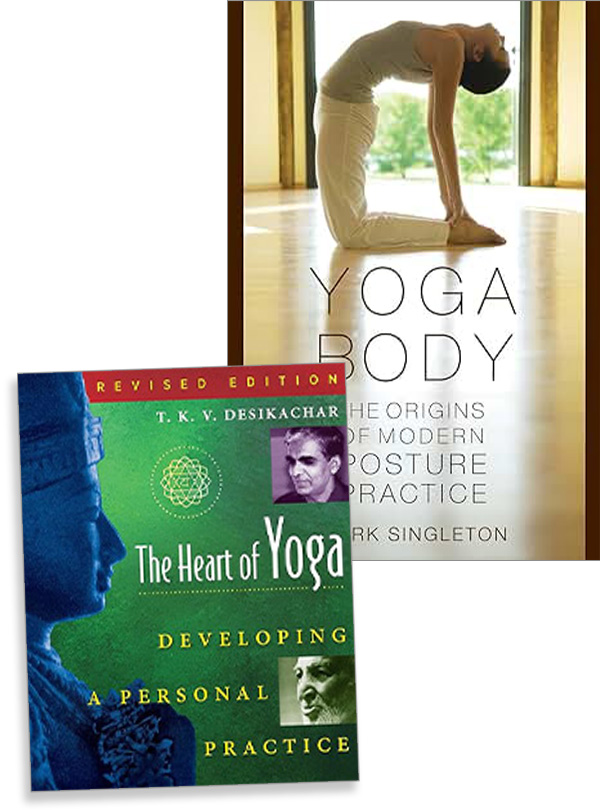
T.K.V. Desikachar’s The Heart of Yoga is the natural starting point – a gentle, practice-adapted-to-the-person approach from one of the most respected teachers of the modern era, rather than a one-size-fits-all manual.
For something more contemporary, Mark Singleton’s Yoga Body: The Origins of Modern Posture Practice traces exactly how the posture-led style most of us now picture came together in the 20th century – the history behind the “Where it comes from” section above, told in full.