
Grounding is the technique you reach for when the feeling has already arrived – the rising panic, the sense of the room receding, the thoughts running faster than you can follow.
It does one narrow thing very well: it pulls your attention out of the spiral inside your head and back into the plain, physical fact of where you are. No equipment, no quiet room, no preparation – just your senses and the world in front of you.
That narrowness is the point. Most of what this survey covers is a practice – something you build over weeks and return to daily. Grounding is different: it’s a tool for the acute moment. It won’t treat the underlying anxiety, but it will, reliably, help you get through the next few minutes.
How to do it
The method below is the standard one. It doesn’t need to be done perfectly or in order. The act of looking for the things is doing the work, whether or not you find all five.
- Five things you can see. Look around and name them, silently or aloud. Be specific – not “a window” but “the chipped paint on the window frame”. Detail pulls attention harder.
- Four things you can touch. The chair under you, the floor through your feet, the fabric of your sleeve, the phone in your hand. Notice the actual sensation – texture, temperature, weight.
- Three things you can hear. Let your attention move outward to the furthest sound you can catch, then back to the nearest.
- Two things you can smell. If you can’t find a smell, name two smells you like. The searching counts.
- One thing you can taste. Coffee, mint, the inside of your own mouth. Or simply the last thing you ate.
If you reach the end and still feel adrift, start again. There’s no failure state here – the only way to do it wrong is not to do it.
Where it comes from
Grounding emerged from trauma therapy through the 1990s, in the treatment of post-traumatic stress and dissociative disorders – states in which a person becomes detached from their surroundings, flooded by memory, or swept up in panic.
Therapists needed something a distressed person could do immediately, without training and without thinking clearly, to re-establish contact with the present. The answer turned out to be the senses – the best known form is the 5-4-3-2-1 method, the version taught above.
It has since travelled far beyond the therapy room and is now among the most widely taught anxiety interventions anywhere – in schools, on crisis lines, in the apps on your phone. Its spread is a fair measure of how useful it is.
Worth knowing
Anxiety feeds on attention – the mind circles a worry, the body responds as though it were a threat, and round it goes. Grounding interrupts that loop not by arguing with the thought, which rarely works mid-spiral, but by giving your attention somewhere else to be: something real, present and undeniable, with less of the mind left free to run the loop.
It’s a redirection of attention rather than a calming of the body directly, which is worth knowing since it sets realistic expectations. Grounding doesn’t switch off the alarm – it gives you something to hold while the alarm subsides on its own, which it generally does. For panic in particular, where part of the fear is the feeling of losing control, simply having a thing to do can break the worst of it.
The limit is the one already stated: grounding manages a moment, it doesn’t resolve the thing generating the moments. If you find yourself needing it often, that’s useful information – worth taking to a doctor or therapist – not a failure of the technique. Used for what it is, though, it’s one of the most quietly reliable tools on this entire site.
Recommended reading
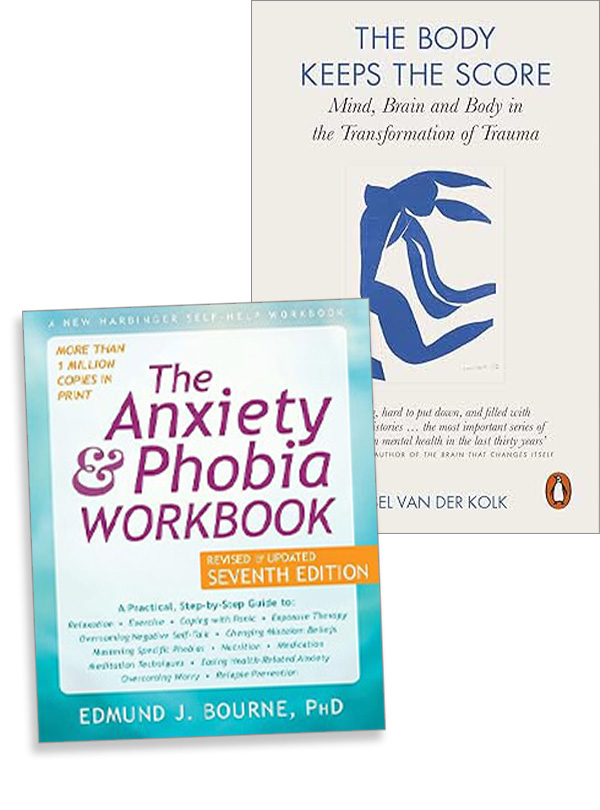
Edmund Bourne’s The Anxiety and Phobia Workbook is the natural starting point – a practical, exercise-based workbook that includes grounding alongside the wider set of tools it sits within.
For something more contemporary, Bessel van der Kolk’s The Body Keeps the Score is the definitive account of why body-based techniques like this one matter – the clinical thinking behind the tool, from one of trauma therapy’s leading figures.