

Cognitive behavioural therapy rests on a deceptively simple idea: that our thoughts, our feelings, and our actions are bound together, each pulling on the others.
By working on the thoughts and the actions, which we can reach, we can shift the feelings, which we often cannot reach directly.
It’s the most thoroughly tested talking therapy in existence, and for anxiety and depression it’s usually the first treatment a doctor will recommend.
How to do it
The thought record is CBT’s signature exercise, and you can use it on your own. It’s simply a way of slowing down the rush from event to feeling, so you can examine the thought hiding in between.
Next time a wave of difficult feeling arrives, work through it on paper.
- The situation. Write down what was happening when the feeling hit. Where you were, what you were doing, who was there – just the plain facts.
- The feeling. Name the emotion, and rate how strong it is, nought to a hundred. Anxious, eighty. Low, sixty. Putting a number on it makes it something you can watch change.
- The automatic thought. Catch the thought that ran through your mind as the feeling rose. This is the hard part – the thoughts are fast and feel like fact. Something like: I have ruined everything. They think I am a fool. I cannot cope.
- The evidence. Now weigh it. What genuinely supports the thought? And what stands against it – what would you say to a friend who said this about themselves? Be as fair to yourself as you would be to them.
- The balanced view. Write a fairer, more accurate thought that takes in both sides. Not relentless positivity – just the truer, more complete picture. Then rate the feeling again, and notice whether the number has moved.
Done a few times, the thought record stops being an exercise on paper and becomes a habit of mind – a small instinct to pause, catch the thought, and question it, before the feeling has the last word.
Where it comes from
CBT grew from the work of two people arriving at the same place from different directions. In the 1950s the psychologist Albert Ellis began challenging the irrational beliefs he saw driving his clients’ distress.
A decade later the psychiatrist Aaron Beck, treating depression, noticed his patients were plagued by a stream of automatic negative thoughts – swift, harsh, and largely unexamined – that coloured everything they felt.
Both concluded that distress wasn’t caused by events alone, but by the interpretations laid over them. Change the interpretation, and the feeling changes with it.
From that root grew a structured, practical therapy – usually brief, focused on the present rather than the distant past, built around specific tools and homework rather than open-ended conversation.
That structure is also why it became the most researched therapy of all: a treatment you can write down, teach consistently, and measure is one you can put to the test in trials – and tested it has been, more than any other.
Worth knowing
The central move in CBT is putting a gap between an event and your reaction to it – a thought flashes through, often too fast to catch, and a feeling follows before you’ve questioned whether the thought was even accurate.
The behavioural half works from the other side, changing what you do so that action can disprove a fear that thinking alone cannot. It’s not the event that disturbs us, but the view we take of it.
The evidence is genuinely strong, and precise about where: CBT is the best-supported treatment for anxiety disorders and depression, and it helps with insomnia, panic and OCD too – firm ground, though it thins for some other conditions and suits some people better than others.
Because it’s structured and present-focused, it can feel mechanical to those wanting to understand the deeper roots of their distress, working on the symptom more readily than the cause. For many that’s exactly enough; for some it isn’t, and that’s worth knowing going in.
What you can do alone with a thought record is the real thing in miniature, and for everyday low moods it can carry you a long way.
But CBT proper is a course of work with a trained therapist, and if you’re dealing with persistent depression or an anxiety disorder, that’s what the evidence supports – in many places you can refer yourself without going through a doctor.
Recommended reading
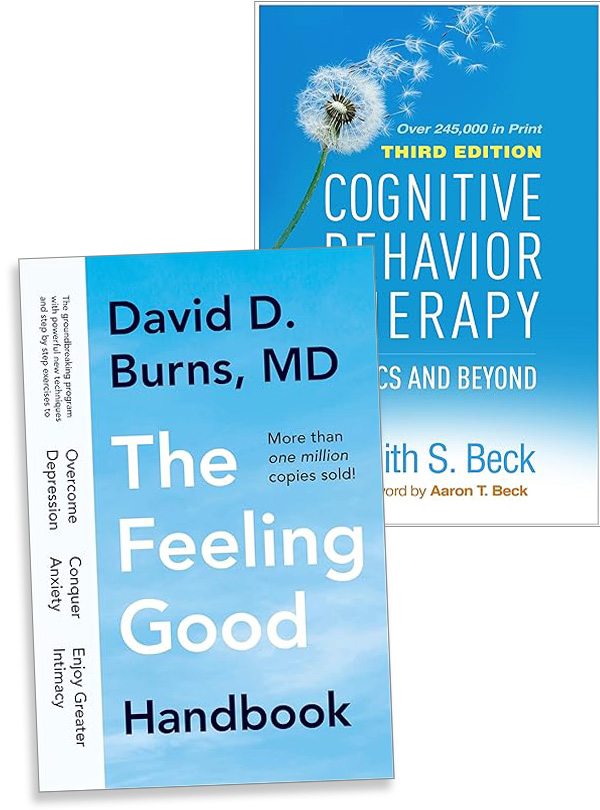
David Burns’s Feeling Good: The New Mood Therapy is the natural starting point – the classic, hugely popular CBT self-help book, and still one of the clearest.
For something more detailed, Judith Beck’s Cognitive Behavior Therapy: Basics and Beyond is the standard clinical text, from the Beck Institute her father founded.