

You begin by asking for help with a message. Halfway through explaining why it is difficult to write, you realise the message is only part of what has been bothering you.
Putting a situation into words can bring out distinctions that were harder to see while it was all circling in your head. Perhaps you know what happened, but not what you want to ask for. Perhaps the decision is clearer than the conversation it will require.
A general-purpose AI chatbot offers somewhere to work on that first account. You can ask it to summarise, suggest questions or help you find words that sound like something you would actually say.
Its suggestions give you something to respond to. “That isn’t quite what I mean” can be a useful discovery, provided you keep correcting the account rather than accepting it because it reads well.
The tool only has the version you give it, and can fill gaps with convincing assumptions. Keep that in mind particularly when discussing someone else: it cannot tell you what they were thinking.
Starting with the question you have
Bring one situation and a manageable task. You might want help preparing a conversation, sorting competing concerns or working out what you still need to know.
- Explain the situation in your own words first. A rough account is enough. Include what you are unsure about, rather than asking the chatbot to decide what the problem is.
- Ask for something you can examine. “Summarise the main concerns” or “What questions have I left unanswered?” gives you a useful starting point. Correct anything that changes your meaning.
- Invite another possible interpretation. Ask what you might be overlooking. Treat the answer as a suggestion to consider, especially when it concerns another person’s intentions.
- Leave identifying details out. You can usually explain a disagreement or decision without names, addresses or private information about other people. Check the service’s data policies before sharing anything sensitive.
- Take one useful thing away. A question to ask, a draft to revise or a clearer sense of your priorities may be enough. Close the chat and give yourself room to act or think further.
You do not need to leave with a complete answer. Sometimes the useful result is smaller: knowing which part needs a conversation, or recognising that you need more information before deciding.
A draft should still sound like you. Read it aloud, remove anything you would never say and check that it asks for what you actually need.
Something to think with
This sits alongside familiar ways of working a thought out: making notes, rehearsing aloud or explaining the situation to someone who asks a helpful question.
A chatbot adds a quick response. It can rearrange what you have written, offer a different wording or suggest a distinction you had not considered.
That responsiveness can be convenient. It can also interrupt your own thinking, particularly if you ask for an answer before giving yourself time to form a view.
You might try writing a few lines before opening the chat. Afterwards, compare them with what came back. What became clearer, and what got lost?
When a good explanation fits too neatly
A complicated disagreement can sound surprisingly simple once a chatbot has described it. The explanation may feel relieving, especially if it places you firmly in the right.
Pause before adopting it. The other person has not had a chance to give their account, and the system may have agreed with yours too readily.
Asking it to challenge you can introduce alternatives, but those need checking too. A confident objection is no more reliable simply because you requested disagreement.
Research is exploring how AI affects reasoning and reliance on advice. It does not yet establish that talking through personal worries with a chatbot improves wellbeing, or works better than writing alone.
For a consequential decision, use the exchange to identify what needs checking. Health, financial and legal questions may require reliable sources or professional advice beyond the conversation.
Knowing when you have enough
Notice if you keep asking the same question in slightly different ways, hoping for a reply that finally removes the uncertainty. Another answer may not give you what you are looking for.
Write down what you know, what you cannot yet know and the next step available to you. Some decisions remain uncomfortable even after you have thought about them carefully.
Where another person is involved, preparation can only take you so far. A conversation gives them room to explain themselves and may reveal something no amount of rehearsal could supply. That is part of the value of staying in touch.
If you would rather hear your own thoughts for a while, journalling and writing offers that space. You can choose the form that helps with the particular question in front of you.
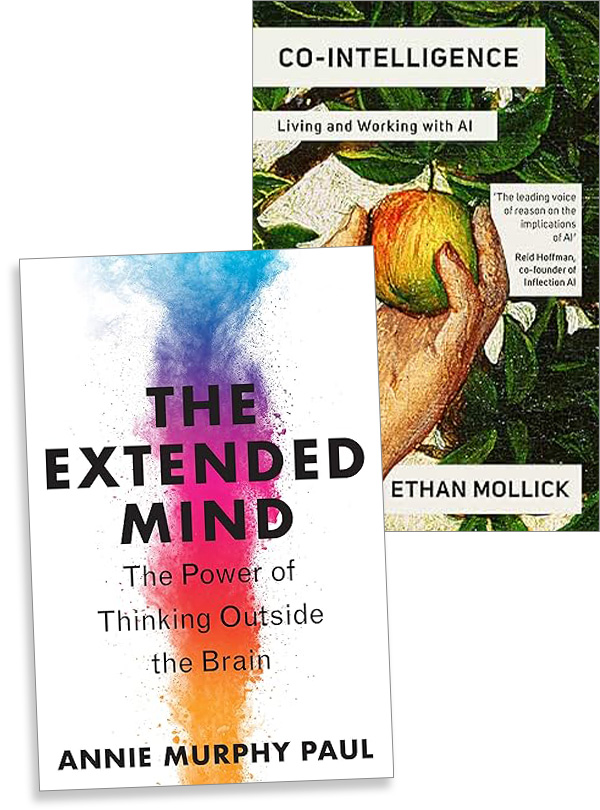
Recommended reading
Annie Murphy Paul’s The Extended Mind explores how our bodies, surroundings and relationships help us think, with practical examples of looking beyond effort inside our own heads.
Ethan Mollick’s Co-Intelligence looks directly at working with generative AI, offering ways to explore its possibilities while keeping your own judgement involved.