
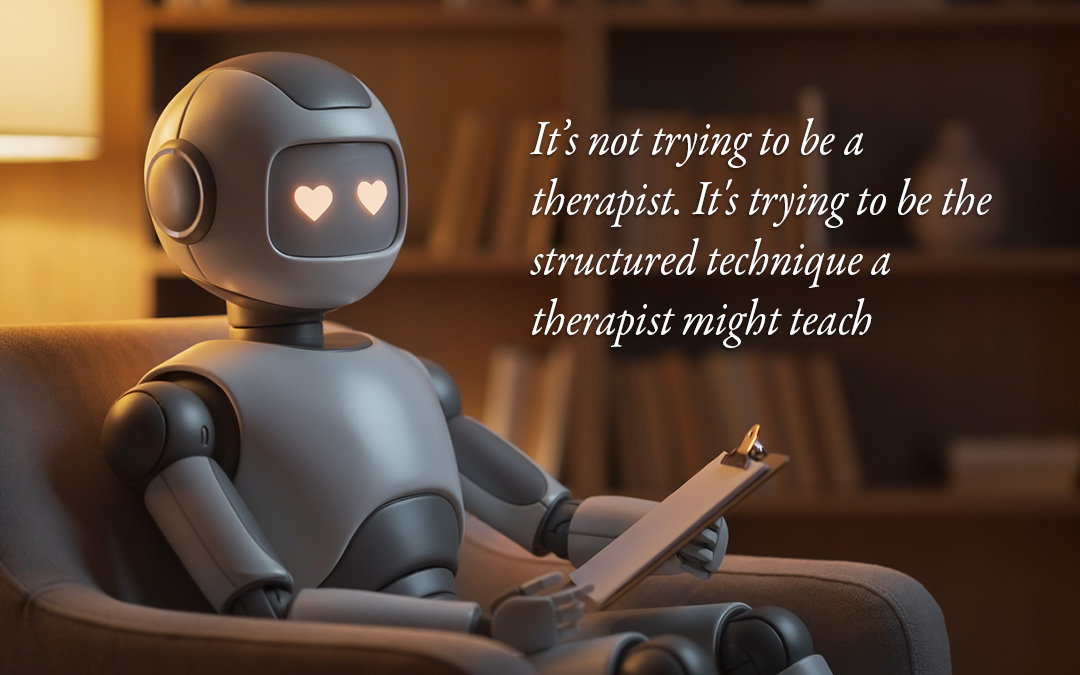
An exercise can seem straightforward when someone explains it, then become surprisingly hard to remember when you want to try it on your own. Where do you begin, and what comes next?
Digital guidance can put those steps within reach. A prompt might help you return to a familiar breathing practice, work through a thought record or find a few minutes for meditation.
Some tools follow a planned sequence. Others use AI to generate instructions around what you tell them. Being able to ask for a shorter explanation or clarify a step can be appealing when you are tired or finding it difficult to concentrate.
Personal wording can also make guidance feel more attentive than it really is. The system may misunderstand your situation or suggest something unsuitable, even when the reply sounds reassuring.
If you are receiving care, a useful place to begin is with exercises you have already discussed with your clinician. Ask whether a particular tool could help you practise between appointments.
You can also use a recording or written instructions. The helpful part may be having guidance available, rather than having it generated afresh.
One exercise at a time
Choose something familiar and manageable. You do not need to explain your whole life, complete a programme or feel better immediately for a session to be useful.
- Begin with a specific exercise. A familiar grounding sequence or a practice agreed with your clinician gives you somewhere clear to start. Ask for the steps to be explained simply if you need that.
- Keep the session within the time you have. A short exercise may be easier to approach on a busy or difficult day. You can stop without completing everything the tool suggests.
- Share only the details needed. Leave out names and identifying information where possible. Check how the service stores and uses conversations before sharing anything sensitive.
- Notice when the guidance feels wrong for you. You do not need to fit your experience to its interpretation or continue an exercise that increases distress. Pause and ask a qualified person for help if needed.
- Bring useful observations to your next appointment. Note what you tried, what helped and what was difficult. Your own account matters more than an app’s summary or progress score.
Some days, following the steps may be enough. On others, you may discover that the exercise is difficult, or that this is not the moment for it.
That is useful information to take back to someone who can help you adapt the practice. It does not mean you need a more persuasive chatbot or a longer session.
What the guidance is built from
Many digital tools draw on exercises developed within established approaches, such as cognitive behavioural therapy. The familiar structure can make them easier to recognise and return to.
Earlier chatbots often guided users through planned exchanges. Newer systems can produce more varied replies, responding to the wording of a question or the details of a situation.
That flexibility may be convenient, but it makes the particular tool important. Using the language of a recognised therapy does not establish that every response follows its principles or suits your needs.
Encouraging findings, with limits
Some carefully developed tools have helped participants in clinical trials. There is reason to investigate them further, alongside questions about who benefits and what support is needed.
A small 2017 study of Woebot found a greater reduction in reported depression symptoms than an information-only resource after two weeks. Anxiety improved in both groups, without a clear advantage for the chatbot.
A 2025 trial of the generative system Therabot also found symptom improvements compared with a waiting-list group. It did not directly compare the tool with treatment from a therapist.
These studies concern particular systems and research arrangements. Their results cannot be transferred to any app that calls itself “AI therapy”, or to a general-purpose chatbot asked to act as a therapist.
For meditation, personalised instructions may feel engaging. We should still distinguish that appeal from evidence that generated guidance works better than a recording or a teacher.
Keeping someone in the picture
There is more to care than finding the right exercise. A professional can ask about changes in your life, notice when an approach needs adjusting and take responsibility for responding to risk.
If you are waiting for an appointment, keep that route open. A tool may help you organise questions or practise something familiar, but it cannot reliably assess everything that needs attention.
You might find that ordinary guided meditation or written breathing instructions give you enough structure without a conversation.
If symptoms worsen or an exchange leaves you confused or distressed, stop and seek human support. For urgent distress or immediate danger, contact an appropriate urgent support service rather than relying on the tool.

Recommended reading
Eric Topol’s Deep Medicine explores the possibility of using AI to give healthcare professionals more time for the people they care for.
Brian Christian’s The Alignment Problem follows the people trying to make machine-learning systems serve human values, including questions of bias, reliability and responsibility.