
Safe-place visualisation means imagining somewhere you would feel comfortable and at ease. You might recall a familiar room, picture a quiet garden or invent a place with details you enjoy.
You explore that setting through imagined sights, sounds and sensations: the light through a window, birds nearby or the support of a comfortable chair. Some people find this a useful focus when they feel worried or unsettled.
The place does not have to feel completely safe. If that word feels difficult, try thinking of somewhere restful or simply pleasant. You can change any detail that brings up an unwanted memory.
You do not need a clear mental picture. Words, an imagined sound or a general sense of the setting may be easier to work with.
If imagining a place feels uncomfortable or leaves you less connected to your surroundings, stop. Grounding techniques, which focus on what is around you now, may suit you better.
How to try it
Start with a brief attempt when you are somewhere comfortable and unlikely to be interrupted. Keep your eyes open or closed, as you prefer, and explore only the details you want to include.
- Choose a comfortable setting. Recall somewhere you like or invent a place: a quiet room, a garden or a sheltered spot outdoors. Include people or animals if you want their company. Change anything that feels uncomfortable.
- Explore a few details. Imagine the light, a nearby sound or the texture of a seat beneath you. Use whichever senses come easily; you do not need a vivid picture or a complete scene.
- Notice your response. Spend a few moments with the setting. Does it feel pleasant, neutral or unsettling? You can adjust it or stop. If distress increases, look around your actual surroundings and notice a few familiar objects.
- Choose an optional reminder. Give the place a name or choose a word that describes it. This may help you recall the setting when you try again, though it does not guarantee a particular feeling.
- Finish and practise again if useful. Bring your attention back to the room, feel the support beneath you and move gently before continuing your day. Try brief sessions when you feel reasonably settled, rather than first attempting it during intense distress.
If an image becomes uncomfortable, stop and look around the room you are in. You can change the setting another time or leave visualisation aside. You do not need to keep searching for a place that works.
How imagery is used in therapy
Imagery is used in several psychological approaches. A therapist might help someone imagine a restful setting, rehearse a difficult situation or work with an upsetting memory. These exercises have different purposes and are not interchangeable.
Safe or calm-place imagery is one option used during preparation for EMDR (eye movement desensitisation and reprocessing), a therapy for processing traumatic memories. The therapist helps the person explore imagery and sensations they find comfortable before deciding how to proceed.
This does not mean everyone needs an imagined safe place before therapy can begin. Preparation should suit the person, and other ways of managing distress may be more helpful.
The exercise on this page is a simple relaxation practice. Trying it on your own does not reproduce EMDR or its treatment of traumatic memories.
What the evidence suggests
Research into guided imagery suggests it may help with anxiety or discomfort in some settings, including around medical procedures. However, studies use different exercises, and confidence in many findings is limited.
That research does not establish that this particular safe-place exercise reliably reduces distress. Some studies also combine imagery with relaxation or other support, making its separate contribution harder to judge.
Imagined experiences can affect how you feel: remembering a pleasant afternoon may feel different from picturing a difficult conversation. But an imagined setting does not guarantee slower breathing, relaxed muscles or a sense of safety.
When to adapt it or seek support
Choose the exercise according to your response. A mildly pleasant or neutral experience may be enough to make it worth trying again; a vivid picture or a strong feeling of calm is not required.
If imagery brings up distressing memories or makes you feel disconnected from the room, stop and turn your attention to your surroundings. A familiar object, an ordinary sound or talking to someone may be more useful.
A guided recording can provide prompts, but you can ignore instructions, keep your eyes open or finish early. Choose guidance that allows you to change the imagined setting.
If you want to use imagery to cope with recurring flashbacks or trauma-related distress, discuss it with a qualified therapist. They can help you decide whether it suits you and explore alternatives. Visualisation alone is not a treatment for trauma.
Recommended reading
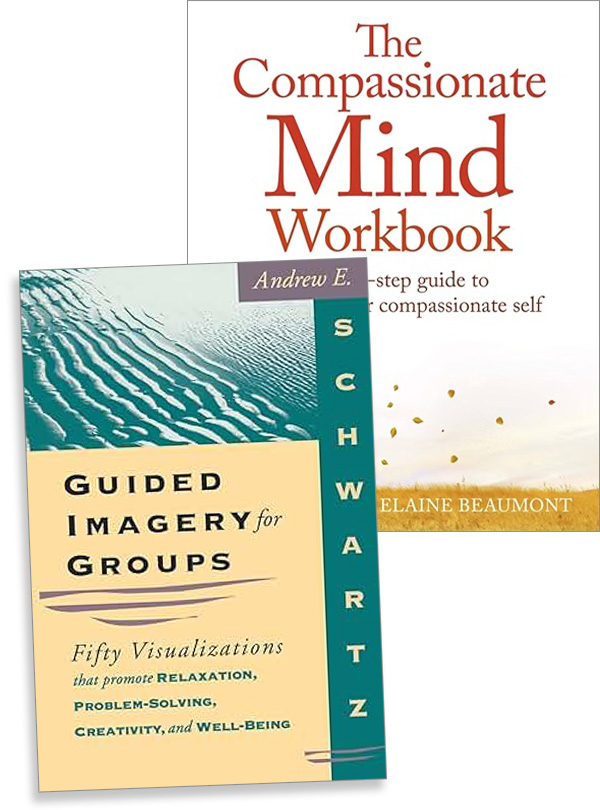
Andrew E. Schwartz’s Guided Imagery for Groups collects scripts for relaxation, creativity and other uses of imagery, with guidance for leading group exercises.
It is aimed mainly at therapists, educators and workshop leaders. It may interest you if you want to explore how guided exercises are put together, rather than follow a short introduction to safe-place visualisation.
Chris Irons and Elaine Beaumont’s The Compassionate Mind Workbook includes safe-place imagery within a practical introduction to compassion-focused therapy.
The two UK clinicians use exercises, prompts and case examples to explore how you respond to difficulties and relate to yourself. It offers a wider framework for trying imagery, rather than focusing only on visualisation.