

Somatic techniques start from a simple observation: calm is something the body does, not something the mind decides. You can know perfectly well that you are safe and still feel your shoulders up around your ears.
Somatic work goes at it from the other end – through sensation, posture and movement rather than argument – on the principle that if you can change what the body is doing, the mind tends to follow.
How to do it
This is a basic somatic settling practice you can do sitting or standing, in a couple of minutes, with nothing but your own attention.
Somatic work asks you to turn towards sensation, and for most people that’s settling. But if you carry trauma, strong sensation can sometimes feel like too much rather than too little – the body floods rather than releases.
If that happens, come back to something neutral and steady: open your eyes, look around the room, feel your feet, name a few ordinary objects.
You’re not failing the practice by stopping – knowing when to stop is the practice, and if sensation work reliably overwhelms you, it’s worth doing this kind of thing with a trained somatic or trauma therapist rather than alone.
- Arrive in the body. Sit or stand comfortably. Take one slow breath and let your attention drop from your head down into the rest of you. You are not trying to relax yet – just to notice that you have a body, and that you are in it.
- Find the ground. Feel your feet on the floor, or the seat beneath you. Press down gently and notice the surface pressing back. This contact is the anchor you return to whenever attention scatters.
- Scan, don’t judge. Move your attention slowly through the body – jaw, shoulders, chest, belly, hands. Wherever you find tightness or holding, don’t try to fix it. Just let it be noticed. Attention alone often begins to loosen things.
- Lengthen the exhale. Breathe in for a count of about four, then out for a count of about six. The long out-breath is the part that tells the nervous system the threat has passed. Do this for five or six breaths.
- Let movement happen. If the body wants to shift – a roll of the shoulders, a stretch of the neck, a small sway – let it, slowly. Somatic work trusts these spontaneous movements as the body discharging tension. Follow them rather than directing them.
- Settle and notice. Come back to stillness. Take a moment to feel whatever has changed – even if it is small. Closing on what is different, rather than chasing more, is what lets the calm stay.
Where it comes from
The word just means “of the body”. As a field, somatic work covers a loose family of approaches – Somatic Experiencing, sensorimotor psychotherapy, Hakomi, Feldenkrais and others – that share one idea: the nervous system holds the residue of stress and threat in the body, and the body can be invited to release it.
You don’t need any of the formal training to borrow the core moves – the everyday version is mostly a matter of turning your attention inwards, noticing what’s actually happening in the body, and letting it shift at its own pace rather than forcing it.
Worth knowing
When you’re stressed, the thinking brain isn’t really in charge – the older, faster parts that govern the fight-or-flight response are. That’s why “just calm down” so rarely works, and why a racing mind can’t usually talk itself still.
The body, though, is always listening. A long exhale, a softened jaw, a sense of the ground under your feet – these speak to the nervous system in its own language, below words. Somatic techniques simply send that signal deliberately, rather than waiting for it to arrive on its own.
The real value of this practice is that it makes you fluent in your own signals. Once you know what your tension feels like – the held breath, the raised shoulders, the clenched stomach – you start to catch it earlier, in a meeting or a queue or a difficult phone call.
A single long exhale and a moment of feeling your feet, done quietly and often, does more over time than any grand practice done rarely. The body learns calm the way it learns anything: by repetition, gently.
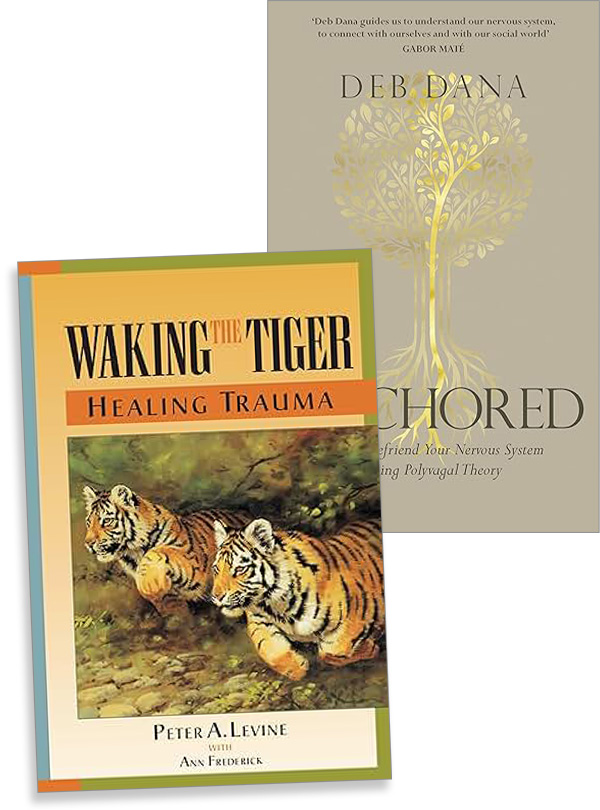
Recommended reading
Peter Levine’s Waking the Tiger is the natural starting point – the foundational text behind Somatic Experiencing, from the approach’s own originator.
For something more contemporary, Deb Dana’s Anchored is a practical guide to working with the nervous system directly, built around the same body-first principle as this page.