
A daily sit is a visit. A silent retreat is moving in – and the difference in intensity is the entire point. It isn’t a more serious version of a daily habit. It’s a different kind of event, closer in shape to a fast or a vigil than to twenty extra minutes of stillness.
The near-total withdrawal is deliberate. Ordinary life runs on a continuous stream of small distractions – conversation, reading, the next task – that a daily practice never fully escapes. Remove all of them at once, for long enough, and what surfaces tends to be considerably less filtered.
How to do it
This isn’t something to design yourself – but there’s a right way to approach committing to it.
- Start with the ten-day format, not a shorter taster. The standard course is built to work as a whole – the effect tends to arrive in the second half, which shorter versions often don’t reach.
- Choose an established, donation-based centre. The Goenka-tradition network runs a consistent, well-tested schedule worldwide, rather than a variable programme designed by an individual teacher.
- Tell the centre the truth on your application. Most screen for current mental health difficulties for good reason – this isn’t the moment to underplay anything.
- Go in with nothing to prove. Leaving early if it isn’t right for you, right now, is a legitimate outcome, not a failure to push through.
- Don’t book it as your first encounter with meditation. A daily practice, even briefly, gives you something to recognise once the retreat strips everything else away.
None of this guarantees a particular outcome. What it does is give the ten days the best possible chance of doing what it’s actually built to do.
Where it comes from
The technique is old. The format most people now encounter it in is comparatively recent.
Vipassana – “insight” – describes a specific style of meditation within the Buddha’s original teaching, focused on observing bodily sensation without reacting to it. For centuries it was taught within monastic settings, on monastic timelines.
The standardised ten-day residential course, open to lay people with no religious affiliation required, was built and popularised by the Burmese-Indian teacher S. N. Goenka from the late 1960s onward. That format – not the underlying technique – is what “a silent retreat” now usually means.
Worth knowing
The intensity that makes this effective is also what makes it worth taking seriously before signing up.
Reported effects go beyond what daily practice tends to produce – genuine shifts in perspective are common, but so, for a minority of participants, is real psychological distress surfacing during the retreat.
Most centres screen applicants for this reason, and it’s worth being honest with yourself, and with them, about your current mental health before applying.
This also isn’t the right starting point for meditation generally. Most people are better served by building a regular daily practice first, and treating a retreat like this as something to grow into rather than begin with.
Recommended reading
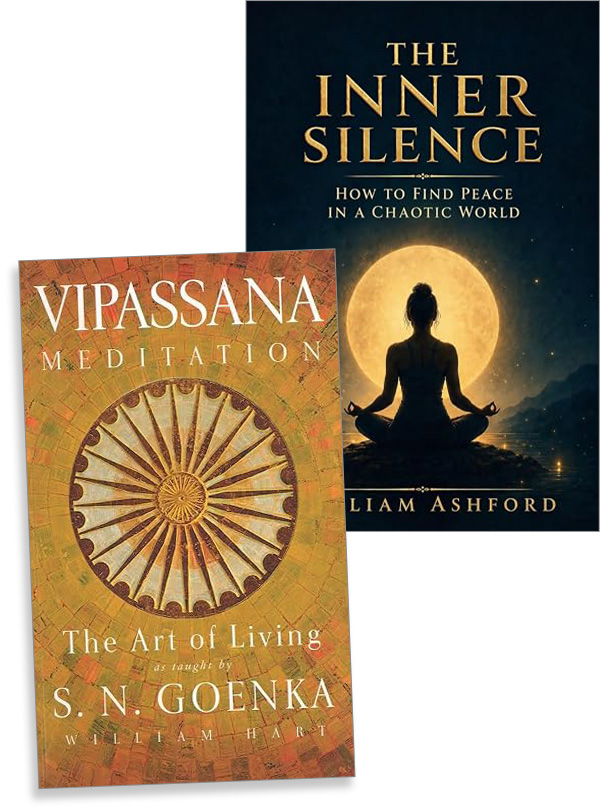
William Hart’s The Art of Living: Vipassana Meditation as Taught by S.N. Goenka is the standard companion text – prepared under Goenka’s own guidance, and the book most retreat centres themselves recommend before or after attending.
For something broader, Christina Feldman’s Silence: How to Find Inner Peace in a Busy World explores the theme of extended silence itself, drawn from decades leading retreats at Gaia House in Devon, one of the UK’s longest-running insight meditation centres.