

Walking in nature helps quieten the mind by allowing the attention to soften and drift. Mindful walking is the opposite approach – and doesn’t require being in a natural environment.
Where the Walking in nature pathway is about the effect of a natural setting on an unfocused mind, mindful walking is a deliberate technique: bringing close, sustained attention to the physical act of walking itself – the lift, the movement, the placing of each foot.
You can do it in a garden, a car park, a hospital corridor, or pacing a small room. The setting isn’t the point. The attention is.
How to do it…
- Slow down, more than feels natural. This isn’t exercise. A pace close to half your normal walking speed gives you enough time to actually notice each phase of the movement.
- Break each step into its parts. Traditionally: lifting the foot, moving it forward, placing it down, shifting your weight. Some people find it helps to silently note each phase as it happens.
- When your mind wanders, bring it back to your feet. Not with frustration – wandering is normal and expected. Each time you notice it’s happened, that noticing is the practice working, not a failure of it.
- Keep your eyes open, gaze low and soft. A few feet ahead is usually enough. This isn’t about shutting the world out, just narrowing what you’re paying close attention to.
- Ten minutes is enough to start. Traditional walking meditation is often done for the same length as a sitting session, but there’s no minimum – even a short corridor, walked slowly and attentively, counts.
Where it comes from
Walking meditation – kinhin – has been practised in Zen Buddhism for centuries, traditionally done in short stretches between periods of sitting meditation, partly to keep the body from stiffening and partly as a practice in its own right.
It reached a much wider Western audience through the Vietnamese Zen teacher Thich Nhat Hanh, who taught walking meditation as an everyday, secular-friendly practice rather than a monastic one – something to do on the way to a car, not just in a meditation hall.
Jon Kabat-Zinn built it into Mindfulness-Based Stress Reduction (MBSR) in the late 1970s as one of the programme’s core formal practices, alongside sitting meditation and the body scan – often specifically offered as an alternative for people who find sitting still difficult.
Worth knowing
Mindful walking engages what researchers call directed attention – effortful, deliberately focused – which is a different mechanism from the softened, effortless attention that time in nature restores. Neither is “better”; they suit different moments and different minds.
It’s often recommended specifically for people who find seated meditation agitating or physically uncomfortable, since the movement itself can absorb some of the restlessness that stillness tends to surface.
Several small studies on walking meditation report reductions in anxiety and improvements in mood comparable to seated practice, though the research base is smaller than for sitting meditation.
Because it doesn’t depend on scenery, it travels well – a corridor, an airport, a small flat all work. If a fuller sense of calm from being outdoors is what you’re after rather than a formal technique, Walking in nature is the better starting point.
Recommended reading
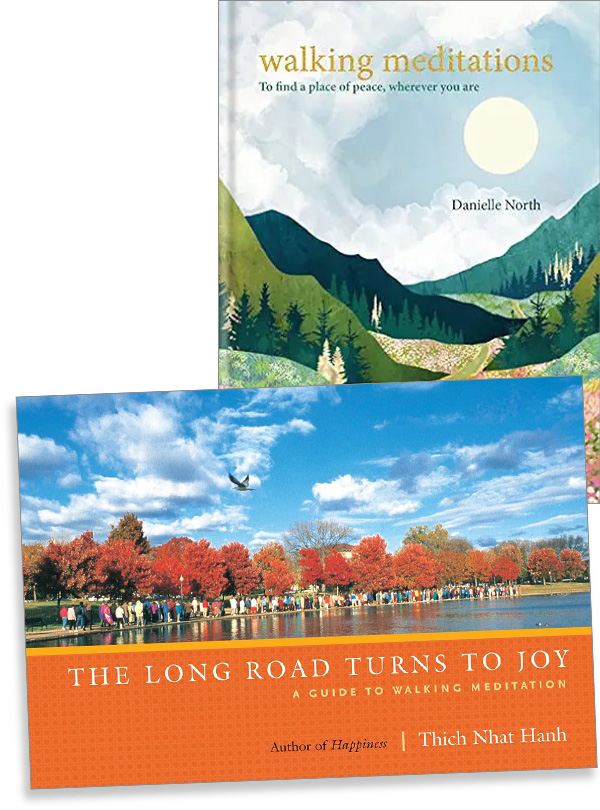
The Long Road Turns to Joy by Thich Nhat Hanh – short, practical, and the book most responsible for bringing this into everyday Western practice.
Walking Meditations by Danielle North – a contemporary, secular-friendly alternative, with none of the specifically Buddhist framing the book above carries.