

Mindful walking means paying attention to walking as you do it: the movement of your legs, the shift of your weight and the contact of your feet with the ground.
You choose a sensation to notice, recognise when your mind has wandered and return to the movement. Thoughts can still be present; you do not need to keep your attention fixed on every step.
Unlike walking in nature, this practice does not depend on natural surroundings. You can try it on a clear indoor path, in a garden or along a familiar pavement. You can also combine the two.
Movement may suit you better than sitting still. Keep your usual mobility aids and choose a pace that feels stable. If walking is painful or impractical, you could explore the same kind of attention during a comfortable seated movement.
How to try it
Begin with a minute or two somewhere you can move safely. Keep your eyes open and remain aware of obstacles, traffic and other people. Your surroundings take priority over concentrating on your feet.
You can slow down a little if that helps you notice the movement, but there is no required speed. Choose one part of the exercise to begin with, rather than trying to monitor everything at once.
- Begin at a comfortable pace. Choose a short, clear stretch of path. Walk at your usual speed or slow down slightly if that feels stable. Keep any mobility aid you normally use.
- Notice one part of the movement. You might feel a foot lifting, your weight shifting or your foot meeting the ground. Choose a sensation you can notice comfortably. There is no need to change your stride or divide every step into stages.
- Return when your attention wanders. When you notice thoughts about something else, bring attention back to your chosen sensation. If focusing on your body feels uncomfortable, try noticing sounds or something around you instead.
- Stay aware of your surroundings. Keep your eyes open and look where you need to for safe movement. Pause the exercise when crossing a road, negotiating obstacles or passing other people.
- Finish after a short stretch. A minute or two is a manageable first try. Stop somewhere safe and notice how the practice felt. You can try it again, extend it gradually or choose an ordinary walk if that suits you better.
From meditation halls to everyday walks
Walking meditation appears in several Buddhist traditions. In Zen, a form called kinhin is practised between periods of seated meditation, continuing the practice while moving.
The Vietnamese teacher Thich Nhat Hanh helped introduce walking meditation to a wider audience. His teaching brought attention to ordinary journeys as well as time set aside for formal practice.
Walking meditation is also included in Mindfulness-Based Stress Reduction (MBSR), alongside sitting meditation, the body scan and mindful movement.
What the research suggests
Small studies of mindful and meditative walking have reported improvements in outcomes such as mood, stress and anxiety. The findings are encouraging, but the research is limited and the methods vary.
Some studies combine walking with other mindfulness exercises or compare it with doing little or nothing. This makes it difficult to tell how much benefit comes from walking, deliberate attention or the wider programme.
There is not enough evidence to say that mindful walking reliably works as well as seated meditation, or that it is better than an ordinary walk.
Choosing how to practise
Movement may feel more comfortable than sitting still, but close attention to bodily sensations does not suit everyone. Try a short stretch and use your response to decide whether to continue.
If concentrating on your steps makes walking awkward, return to your usual stride. You can notice sounds or your surroundings instead, or leave the exercise aside.
Mindful walking and time in nature can overlap. You might pay attention to a few steps, then look around and enjoy the place. There is no need to maintain one kind of attention throughout the walk.
If walking is tiring or painful, choose a shorter route, take seated breaks or try noticing a comfortable movement of your hands or arms. Use the support and mobility aids you normally need.
For a less structured outing, walking in nature offers another starting point. Choose the approach that fits your circumstances, rather than treating either as a test of concentration.
Recommended reading
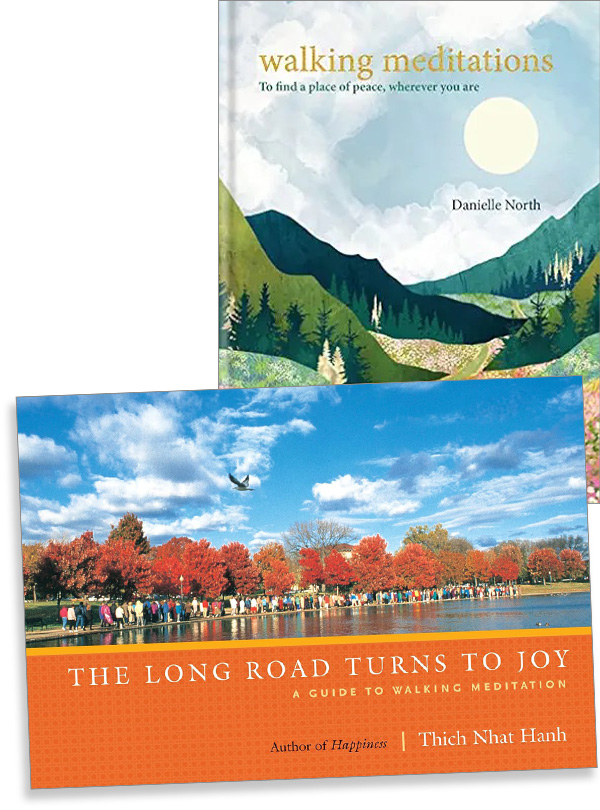
Thich Nhat Hanh’s The Long Road Turns to Joy is a short guide to walking meditation, with instructions, reflections and poems. Rooted in his Buddhist teaching, it explores bringing attention to ordinary walks as well as formal practice.
Danielle North’s Walking Meditations offers exercises for short walks, longer outings and different seasons. It includes practices for noticing your senses and surroundings in both urban and natural settings.