

Meals without conversation, a phone put away, days organised around meditation. A silent retreat changes the familiar rhythm of life, leaving fewer ways to fill a pause or turn attention elsewhere.
That can be part of its appeal: time to practise without fitting it around work, messages and household tasks. It can also be demanding. A quiet setting does not necessarily produce a quiet mind.
Retreats vary in length, teaching and intensity. Vipassana, usually translated as “insight”, belongs to Buddhist meditation traditions; the well-known ten-day courses taught in S. N. Goenka’s tradition are one particular format, rather than a model for every silent retreat.
Finding a suitable starting point
The length of a retreat says little on its own about whether it will be useful. The daily schedule, teaching, available support and a person’s current circumstances all deserve attention before booking.
- Read the daily schedule before choosing a retreat. Look at the hours of meditation, breaks, sleeping arrangements and rules around silence. A shorter introductory retreat may be a useful starting point.
- Ask what support is available. Find out who teaches, how to speak with them privately and what happens if someone becomes distressed. Silence should not prevent asking for help.
- Discuss health needs before booking. Give the organisers accurate information about physical and mental health, medication and relevant past experiences. Where there are concerns, involve a clinician who knows your history.
- Try some regular practice beforehand. Familiarity with sitting or walking meditation can help clarify what feels manageable and which questions to ask about a longer retreat.
- Know how to adjust or leave if necessary. Discuss the centre’s arrangements in advance. Significant distress is a reason to seek support and reassess, rather than assume that continuing will make it beneficial.
The practical arrangements matter as much as the intention to go. Time away from work or caring responsibilities, the cost of travel and a manageable return home all shape what a retreat asks of someone.
There is also a difference between wanting time for meditation and wanting somewhere to recover from exhaustion or distress. A demanding retreat may offer little of the rest or personal support needed for the latter.
What silence changes
Conversation gives a day much of its familiar shape: exchanging news, explaining a mood, filling an awkward pause. On retreat, many of those small exchanges are set aside.
Meals, walking and sitting can become more noticeable in their own right. So can boredom, discomfort and recurring thoughts. Some people find the reduced demands welcome; others find the lack of familiar outlets difficult.
Silence usually applies to conversation between participants, rather than every form of communication. Teaching and private conversations with a teacher may remain available. The arrangements should be clear before arrival.
One tradition, several approaches
Vipassana is commonly translated as “insight”. Within Buddhist traditions, it concerns understanding experience through close observation, including its changing nature.
Different teachers and traditions approach that observation differently. Attention may include breathing, bodily sensations, thoughts and emotions, with sitting and walking practice arranged in various ways.
S. N. Goenka, who began teaching in India in 1969 after training with U Ba Khin in Burma, helped bring one approach to a wide international audience. His tradition’s ten-day courses follow a set programme, moving from attention to breathing towards systematic observation of bodily sensations.
Other insight retreats use different schedules and methods. A ten-day Goenka course is therefore one particular commitment, rather than the definition of a silent retreat or the necessary starting point for everyone.
Intensity needs support
Extended meditation can be meaningful, but its demands should not be mistaken for evidence that it is working. A difficult experience is not automatically a useful one.
Research on meditation has documented unwanted effects, including anxiety and low mood. Evidence from ordinary mindfulness courses cannot simply establish the safety or benefits of days of intensive practice.
Health screening and access to experienced teachers matter. So does the freedom to describe distress plainly, without having it treated as a lack of commitment or something that must be endured.
Persistent panic, severe sleep disruption or a sense of losing touch with reality call for prompt support and reassessment. A retreat is not a substitute for mental health care, and medication should not be stopped to meet a retreat’s expectations.
Coming back to ordinary days
After several days with few conversations or decisions, an inbox, a journey home and a busy household can feel like a sudden change of pace.
Where possible, leaving some space before returning to a full schedule can make that transition easier. Familiar meals, sleep and contact with trusted people may be more useful than trying to explain the whole experience immediately.
What remains valuable may be modest: recognising a familiar reaction sooner, listening more closely or finding a daily practice easier to return to. A retreat does not have to produce a dramatic account to have been worthwhile.
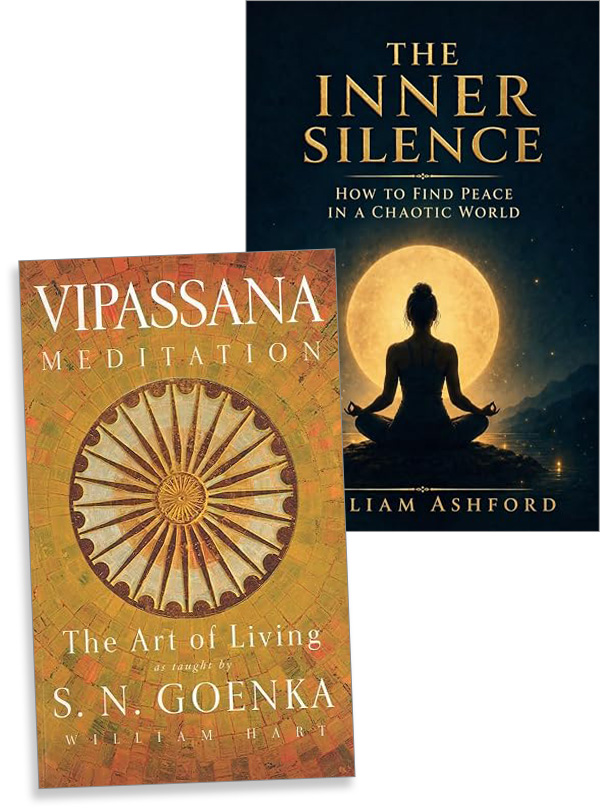
Recommended reading
William Hart’s The Art of Living: Vipassana Meditation as Taught by S.N. Goenka introduces the practice and thinking behind Goenka’s approach. It offers context for that particular tradition rather than a guide to every kind of retreat.
Christina Feldman’s Silence: How to Find Inner Peace in a Busy World explores silence more broadly, considering its place in meditation and ordinary life.