
The placebo effect describes changes linked to the expectation and experience of receiving treatment, rather than its specific active ingredient. These can include changes in how symptoms such as pain are felt.
A placebo might be a dummy pill used in a clinical trial. Feeling better after taking one does not mean the original symptoms were imaginary.
It also does not mean every improvement was caused by a placebo effect. Symptoms can fluctuate, improve naturally or respond to other care someone is receiving.
Researchers have also studied “open-label” placebos, where people know they are receiving an inactive treatment. Some studies report symptom improvements, but this does not establish a reliable method for treating yourself with a ritual or dummy pill.
The practical question here is how to make everyday care more supportive: understand what a treatment is for, ask questions and choose routines you find comfortable. You do not need to convince yourself that something will work.
Putting the idea into practice
The suggestions below concern the experience around care, rather than a way to produce a placebo effect on demand. Use them alongside appropriate treatment, and discuss changes to prescribed care with your clinician.
- Understand the care you are receiving. Ask what a treatment is intended to help, when to review it and which changes to report. Clear information gives you a more realistic basis for expectations than trying to think positively.
- Choose a manageable routine. Set aside a comfortable time for an agreed exercise or use a reminder for prescribed treatment. Keep the routine simple enough to follow; it does not need to become a ceremony.
- Allow room for uncertainty. You might think “This may help, and I can review how it goes.” Doubt or a difficult day does not mean you have prevented treatment from working.
- Notice your response without constant checking. At an agreed review point, consider symptoms, daily activities and unwanted effects. Feeling better is useful information, but does not by itself show that an underlying condition has improved.
- Offer practical, honest support. If helping someone else, ask what they would find useful: company, help attending an appointment or time to talk. Listen without promising recovery or suggesting that their attitude determines the outcome.
What researchers are measuring
In a clinical trial, a placebo resembles the treatment being tested but lacks its specific active component. Comparing the groups helps researchers assess what the treatment adds beyond the experience of receiving care.
Improvement in a placebo group is often called the “placebo response”. It can include natural recovery, fluctuating symptoms, other care and changes in how people report feeling, as well as placebo effects.
To investigate placebo effects more directly, researchers may compare a placebo with no treatment or vary the information and context surrounding treatment. The distinction matters: improvement after a dummy pill does not show that the pill-taking ritual caused it.
Expectation and learning
Expectations and previous experiences can influence symptoms such as pain. What someone is told about a treatment, and what happened when they received similar care before, may affect their response.
Laboratory studies have found changes in pain-related brain activity associated with these processes. This supports a biological contribution, but does not mean every placebo produces the same response or works across all conditions.
There is no single mechanism that explains every finding. Nor does the research establish that attentive care generally has as much effect as a medicine or procedure.
Can a placebo work without deception?
Some trials give participants placebos openly. In a small 2010 study led by Ted Kaptchuk, people with irritable bowel syndrome who knowingly took placebo pills reported greater improvement than a comparison group receiving no pills.
Participants also received an explanation of placebo effects and instructions for taking the pills. The study therefore tested a package of information and treatment ritual, rather than showing that any knowingly inactive pill will help.
Later studies and reviews suggest possible benefits in some settings. Questions remain about which conditions benefit, how long changes last and how much the findings depend on the way studies are conducted.
These results do not justify replacing an effective treatment with a placebo, or assuming that a comforting routine has a proven medical effect.
Feeling better and treating illness
Symptom relief can matter even when the underlying condition is unchanged. But feeling less pain or discomfort does not, by itself, show that an infection has cleared or an injury has healed.
Keep following the monitoring and treatment advice for your condition. A placebo response is not evidence that symptoms were invented, and a lack of improvement is not evidence that someone failed to believe enough.
Equally, feeling better after an unproven treatment does not establish that its ingredients or claimed mechanism work. Benefits, unwanted effects and costs still need to be assessed.
What you can usefully take from this
The practical suggestions on this page concern clear information, comfortable routines and supportive relationships. They are not a tested programme for producing placebo effects.
You can ask your clinician what improvement is realistic and when to review treatment. You can also say when explanations are confusing or care feels rushed.
For everyday comfort, choose something that suits you, such as rest or a familiar routine. It can be worthwhile without being described as medicine or credited with changing an illness.
Recommended reading
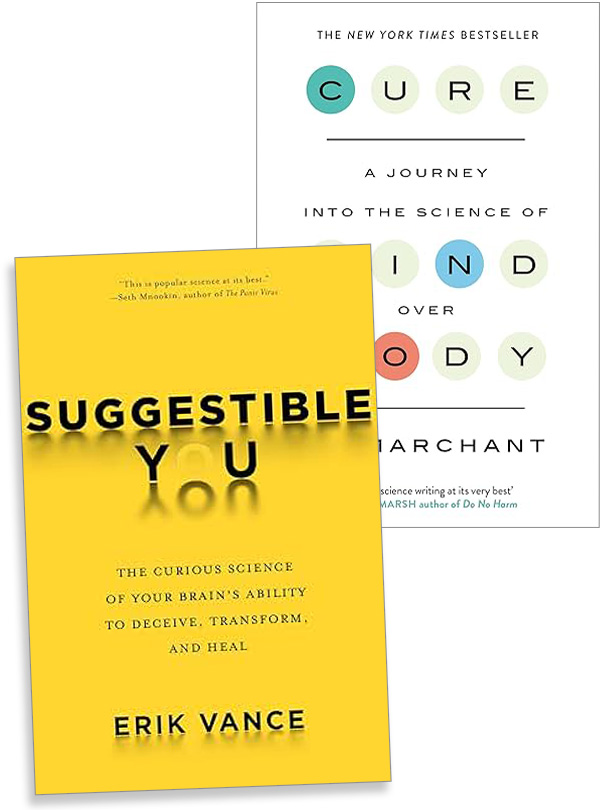
Jo Marchant’s Cure explores research into how thoughts, expectations and the experience of care can affect health. It draws on interviews with researchers, clinicians and patients, including work on placebos.
It offers a broad introduction to the subject rather than a treatment guide. Keep the distinction between symptom relief and treating an underlying illness in mind as you read.
Erik Vance’s Suggestible You examines expectation and suggestion through reporting on placebos, hypnosis and false memories.
It is the more focused choice if you are interested in how beliefs influence experience. Both books discuss research available when they were published in 2016, so they should be read alongside newer findings.