
The STOP technique is a short reminder to pause before responding: Stop, Take a breath, Observe, Proceed. You might use it before sending an angry email, answering a difficult question or acting on an urge.
The pause gives you a moment to notice what is happening and consider your next step. That might mean asking for time, checking a fact or deciding to leave a conversation until later.
You do not need to feel calm before making that choice. You can still be upset and decide that replying immediately would be unhelpful.
Try it first during an ordinary moment, such as before opening a message. A note on your desk or phone can help you remember the sequence when you want to use it.
If focusing on your breathing feels uncomfortable, notice an object nearby or the support of your chair instead. If a situation needs immediate action for safety, take that action rather than work through the exercise.
How to try it
Use the four steps as prompts, at a pace that suits the situation. The aim is to consider your response, rather than suppress your feelings or make yourself relax.
- S – Stop. If it is safe to pause, briefly leave the message unsent or wait before speaking. Give yourself a moment before continuing.
- T – Take a breath. Notice one or two comfortable breaths without forcing them. If focusing on breathing is unhelpful, look at an object nearby or feel the chair supporting you.
- O – Observe. Notice what you are feeling, thinking and wanting to do. What do you know about the situation, and what are you assuming? Keep it brief; you do not need to analyse everything.
- P – Proceed. Choose a next step that fits the situation and what matters to you. You might reply, ask a question, set a boundary or take more time. You can act thoughtfully while still feeling upset.
Two versions of STOP
The version on this page is used in mindfulness guidance: Stop, Take a breath, Observe, Proceed. It offers a short structure for noticing your response before deciding what to do.
A closely related skill appears in Dialectical Behaviour Therapy (DBT), developed by Marsha Linehan. Its wording is Stop, Take a step back, Observe, Proceed mindfully.
In DBT, STOP is taught among skills for managing distress without acting in ways that make a situation worse. Both versions encourage a pause, observation and a considered next step.
You can use this brief exercise without taking a course. However, using one skill is not the same as receiving DBT or completing a mindfulness programme.
What the pause is for
STOP gives you something specific to do when you notice an urge to react. Its usefulness lies in what you do next, rather than whether a breath immediately makes you feel calm.
Before sending a sharp reply, for example, you might notice that you have read an ambiguous message as criticism. You could ask what the sender meant, draft a reply for later or decide that a clear boundary is needed.
The exercise does not tell you which response is right. Sometimes speaking firmly or leaving a situation is appropriate. Pausing should not mean ignoring a problem or accepting harmful behaviour.
Research into broader therapies cannot establish what this four-step exercise will do on its own. It is a practical prompt, rather than a guaranteed way to stop anxiety, anger or an urge.
Making it easier to remember
Choose an ordinary moment to rehearse the sequence: before opening an email, answering a call or starting a task. Keep it brief enough to fit your routine.
If you forget until afterwards, you can still review what happened. What did you notice? What might have helped you pause? Use that information to choose a reminder for next time.
You can also simplify the exercise to “pause, notice, choose”. If breathing draws attention to uncomfortable sensations, look around instead. Grounding techniques offer some options.
When a pause is not enough
During intense distress, it may be difficult to observe your thoughts or consider alternatives. Focus on immediate safety, step away if possible or contact someone who can help.
If reactions or urges repeatedly cause problems, discuss them with a qualified mental health professional. STOP can be one tool within wider support; you do not need to keep trying it alone before asking for help.
Recommended reading
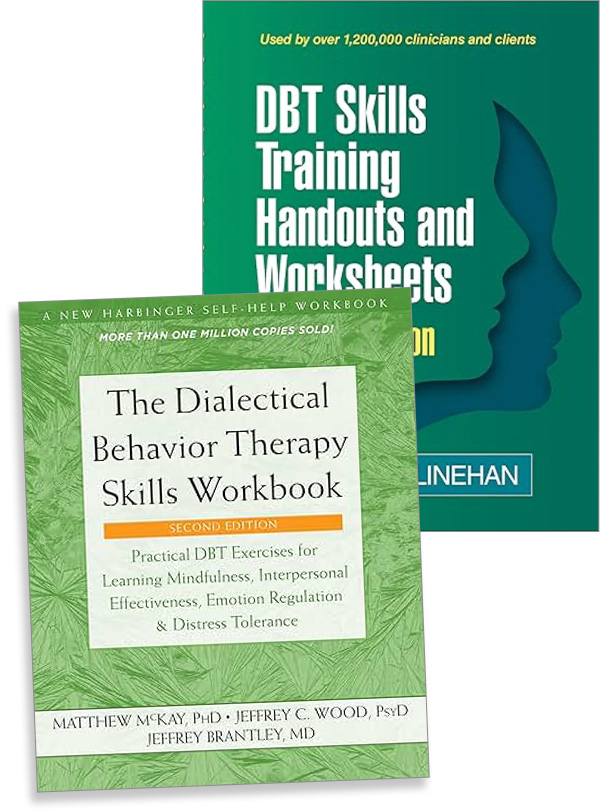
Matthew McKay, Jeffrey C. Wood and Jeffrey Brantley’s The Dialectical Behavior Therapy Skills Workbook offers step-by-step exercises in mindfulness, managing emotions, tolerating distress and handling relationships.
It is a practical option if you want to explore a wider range of skills beyond this brief pause. You can work through relevant sections, with professional support if needed.
Marsha Linehan’s DBT Skills Training Manual explains how to teach DBT skills, including its version of STOP: Stop, Take a step back, Observe, Proceed mindfully.
The manual is written primarily for clinicians and skills trainers. It provides detailed background, but the workbook above is more approachable for everyday use.